Why Finding the Right Divorce Attorney Near Me Makes All the Difference
Why You Need a Divorce Attorney: Navigating Legal and Emotional Waters
Here’s the truth: even the most amicable divorce can quickly become complicated. What starts as a friendly conversation about “splitting things fairly” can turn into heated disagreements over retirement accounts, custody schedules, or who gets the family dog. That’s why having a divorce attorney near me isn’t just helpful—it’s essential protection for your future.
Divorce involves far more than signing papers and going your separate ways. You’re dealing with complex legal requirements, financial decisions that will impact you for years, and emotional stress that can cloud your judgment. Indiana’s family law system has specific rules about everything from property division to child custody, and one misstep can cost you significantly.
A skilled divorce attorney serves as your guide through this challenging time. We steer the legal complexities that vary from state to state and even county to county. In Indiana, we operate under a “no-fault” divorce system, which means you don’t need to prove anyone did anything wrong. However, understanding how this impacts your strategy requires experienced legal guidance.
Perhaps most importantly, your attorney provides objective advice when emotions are running high. When you’re hurt, angry, or scared about your future, it’s easy to make decisions you’ll regret later. We help you step back, see the bigger picture, and make choices that protect your long-term interests rather than just addressing immediate frustrations.
Key Areas Where an Attorney Provides Critical Help
Asset division and debt allocation can be surprisingly complex, even in seemingly straightforward cases. Indiana courts generally divide marital property and debts equally, but there are important exceptions. The court might deviate from the 50-50 split based on who provided the money for specific property, whether assets were received as gifts, each spouse’s current financial situation, and future earning ability. An experienced attorney knows how to present evidence that supports a favorable division for you.
Child custody and support decisions require careful attention to Indiana’s specific guidelines. Child custody and support information from the state of Indiana shows that courts consider multiple factors: the child’s age and preferences (especially for children 14 and older), the relationship between child and each parent, the child’s adjustment to home and school, and any history of domestic violence. We help you understand these factors and present your case in the most compelling way possible.
Spousal support (alimony) in Indiana isn’t automatic—it’s awarded only in specific circumstances. The court may order maintenance when one spouse lacks sufficient property to meet basic needs or is physically or mentally unable to work. The duration and amount depend on various factors that require careful legal analysis and strategic presentation.
Protecting your future extends beyond the immediate divorce proceedings. Property division orders are almost never changed after your final divorce decree, making it crucial to get things right the first time. However, custody arrangements, parenting time, and child support can be modified as circumstances change—another reason why having experienced legal guidance matters.
For comprehensive information about all these issues, explore More on Family Law issues.
Handling the Emotional and Financial Toll
Divorce attorneys don’t just handle paperwork—we help manage the entire process to reduce your stress and protect your financial interests. Strategic planning from the beginning can significantly impact both the emotional toll and the final outcome of your case.
Cost management is a real concern for most families. With the national average divorce cost at $5,470 and attorney hourly rates averaging $366, understanding how to manage these expenses is crucial. We work with clients to develop cost-effective strategies, whether through negotiation, mediation, or collaborative approaches.
Setting realistic expectations from the start helps both your emotional well-being and your budget. Not every divorce requires lengthy court battles. Many cases can be resolved through negotiation or alternative dispute resolution methods, saving both time and money while reducing stress for everyone involved—especially your children.
The key is being organized, communicating openly with your attorney, and seeking compromise when it makes sense. These approaches can significantly reduce legal fees while still protecting your essential interests and rights.
How to Find a Qualified Divorce Attorney Near Me
When you’re searching for a divorce attorney near me, you’re not just picking a name from a directory—you need someone steeped in Indiana law and familiar with the judges and clerks in your county. That local knowledge can save you time, money, and frustration.

Why Indiana-Specific Knowledge Matters
Indiana requires that either spouse live in the state for six months and in the filing county for 90 days. There is also a mandatory 60-day waiting period. A hometown attorney already knows these deadlines, the local court’s preferred forms, and which judges lean toward mediation versus litigation.
Starting Your Search
- Indiana State Bar Association’s referral service – prescreened local attorneys.
- Reputable online directories such as Martindale.com – filter for Indiana family-law lawyers.
- Personal referrals from friends, counselors, accountants, or clergy who have worked with divorce clients.
Factors to Consider When Choosing Your Local Divorce Attorney
- Depth of family-law experience – The more of their caseload that is divorce, the better for you.
- Communication style – During your consultation, notice whether the lawyer listens, explains clearly, and sets realistic expectations.
- Client reviews – Look for consistent praise or recurring concerns rather than one-off comments.
- Fee structure – Flat fees for uncontested matters, hourly rates (often $200–$500) for contested cases. Ask what is and is not included.
For a deeper checklist, read Finding the Right Divorce Lawyer Near Me: Protecting Your Rights & Future.
Making the Most of Your Initial Consultation
Bring recent tax returns, bank and retirement statements, and a list of your questions. The more organized you are, the more specific guidance you’ll receive. Pay attention to how comfortable you feel—divorce can last months, so a good working relationship matters.
To prepare in detail, visit Information on a Divorce Lawyer Indianapolis Free Consultation.
Understanding Different Divorce Approaches and Managing Costs
Divorce doesn’t come in one size. The route you choose—litigation, collaboration, mediation, or an uncontested filing—directly affects stress, timing, and expense. In most cases, lowering conflict keeps more money in the family and lets everyone move forward sooner.
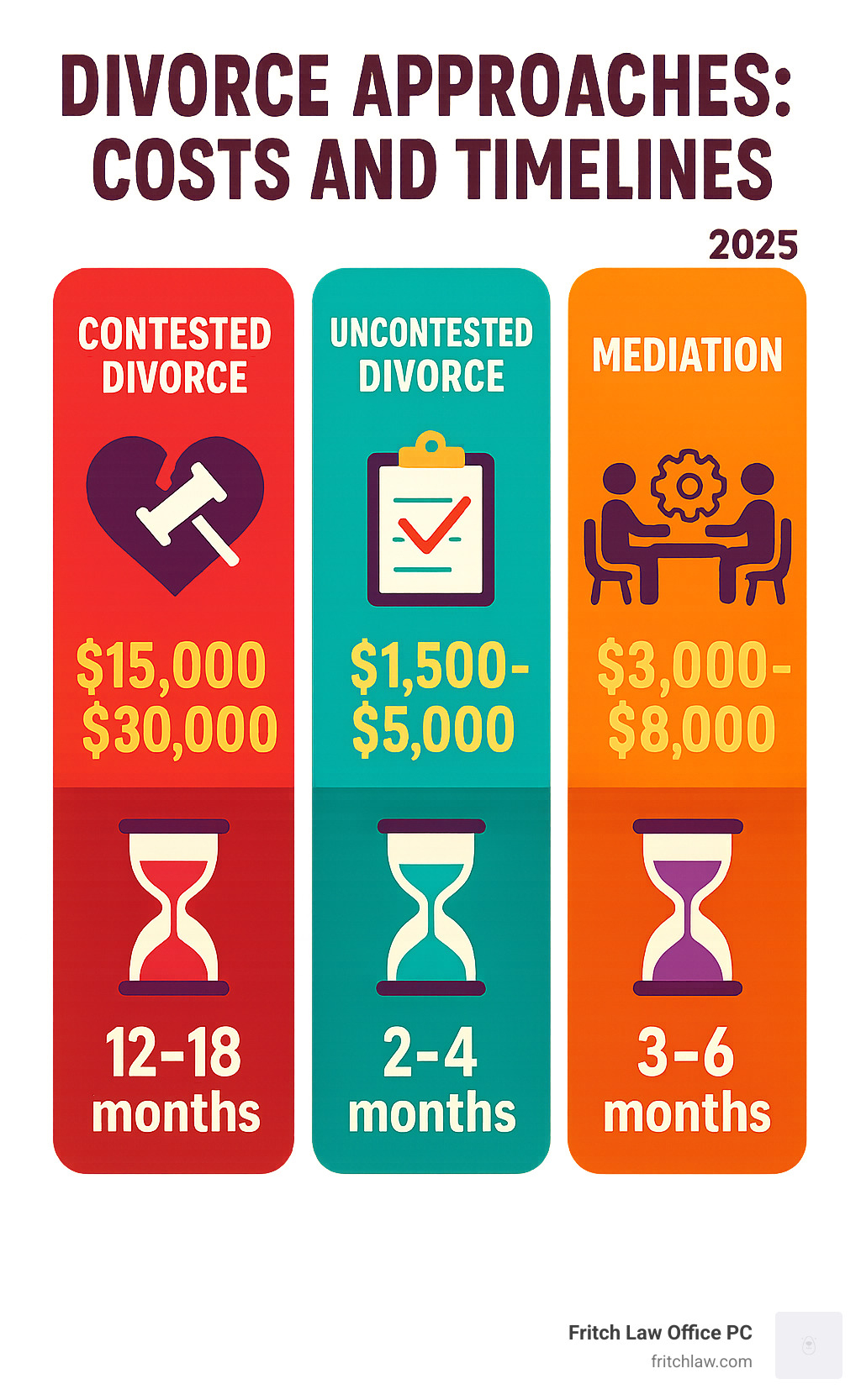
Contested vs. Uncontested Divorce
- Contested – spouses disagree on property, custody, or support; expect multiple hearings, 12–18 months of litigation, and $15,000–$30,000 each in fees.
- Uncontested – all issues are resolved in writing; many Jasper-area couples finalize in 2–4 months for $1,500–$5,000 total, sometimes without a hearing.
Think your matter might qualify? Learn about Uncontested Divorce Attorneys.
Alternative Dispute Resolution
- Mediation – a neutral mediator guides discussion; typical cost $3,000–$8,000 and 3–6 months.
- Collaborative divorce – each spouse has counsel, but everyone commits to settlement; often cheaper and far more private than court.
Cost-Saving Tips When Hiring a Divorce Attorney Near Me
- Ask whether a flat fee is available for simple filings; otherwise, expect an hourly rate (often $200–$500) plus a retainer.
- Organize documents in advance so you’re not paying your lawyer to be a file clerk.
- Batch non-urgent questions into one email to limit billable time.
- Reserve courtroom battles for truly critical issues; compromise on the rest.
Choosing the right approach with an experienced local lawyer can trim thousands of dollars and months of uncertainty.
Preparing for Your Divorce: Documents, Strategy, and Key Issues
Getting ready for your divorce might feel overwhelming, but taking a proactive approach will save you time, money, and stress down the road. Think of it as laying the groundwork for your future – the better prepared you are, the more smoothly things will go.

When you’re organized and ready, your divorce attorney near me can focus on strategy rather than hunting down paperwork. This means fewer billable hours and a more efficient process overall. Plus, being well-prepared shows the court that you’re taking this seriously and have thought carefully about what matters most to you and your family.
Essential Documents to Gather for Your Attorney
Before you meet with your attorney, start gathering the important papers that tell the story of your marriage and finances. It’s like putting together a puzzle – each document helps create a clearer picture of your situation.
Financial records form the backbone of your case. You’ll need your tax returns for the past three to five years, along with bank statements from all your accounts – checking, savings, and money market accounts. Don’t forget about investment account statements like your 401k, IRA, or brokerage accounts. Your pay stubs and employment records show your current income, while business financial statements are crucial if you or your spouse own a business.
Insurance policies matter too – life, health, disability, and property insurance all play a role in understanding your family’s financial picture. Gather up those debt statements as well, including credit cards, loans, and mortgage information. These debts will need to be divided just like your assets.
Property documentation helps establish what you own and its value. This includes real estate deeds and mortgage documents, vehicle titles and loan information, and appraisals for valuable property. Keep an inventory of personal property and gather documentation of separate property – things you inherited or owned before marriage.
You’ll also want to collect any legal documents like prenuptial agreements, previous court orders, adoption papers, military service records, or immigration documents if they apply to your situation.
If you have children, bring their birth certificates, school records, medical records, and documentation of childcare expenses and extracurricular activity costs. These help establish custody arrangements and support calculations.
Protecting Your Interests: Child Custody and Property Division in Indiana
Indiana has specific approaches to handling the two biggest issues in most divorces: where the children will live and how property gets divided. Understanding these basics helps you prepare for what’s ahead.
When it comes to child custody, Indiana courts always focus on what’s best for your children. They’ll look at your child’s age and developmental needs, because a toddler has different needs than a teenager. If your child is 14 or older, the court gives more weight to what your child wants – though they still consider what’s truly best for them.
The court also examines how your child interacts with each parent and how well they’ve adjusted to their current home, school, and community. Everyone’s mental and physical health matters too, along with any history of domestic violence or substance abuse. The Indiana Parenting Time Guidelines provide a starting point for visitation schedules, but every family’s situation is unique.
Property division in Indiana typically follows a 50-50 split, but that doesn’t mean everything gets divided down the middle. The court looks at who contributed money to buy the property, whether property came from gifts or inheritance, each spouse’s current financial situation, and each person’s ability to earn money in the future.
Understanding marital versus separate property is crucial for protecting your interests. Generally, anything acquired during your marriage counts as marital property, regardless of whose name is on the title. Separate property usually includes what you owned before marriage, gifts you received individually, and inheritances.
The key is being strategic about which battles to fight. Some assets might be worth more to you personally than their dollar value, while others might be better left to your spouse if it means a smoother overall resolution.
For guidance custom to your specific situation, Connect with Divorce Lawyers in Jasper Indiana who understand local court procedures and can help protect what matters most to you.
Frequently Asked Questions About Divorce in Indiana
When you’re searching for a divorce attorney near me, you probably have many questions about how the process works in Indiana. These are the most common concerns I hear from clients, and understanding these basics can help you feel more confident as you move forward.
How long do I have to live in Indiana to file for divorce?
Before you can file for divorce in Indiana, either you or your spouse needs to have lived in the state for at least six months. This residency requirement exists to ensure that Indiana courts have the proper jurisdiction to make binding decisions about your divorce.
You’ll typically want to file in the county where you or your spouse currently lives. This local connection is important because it means your case will be handled by judges who understand the community and can make decisions that reflect local circumstances.
If you’ve recently moved to Indiana or your spouse lives in another state, don’t worry – as long as one of you meets that six-month requirement, you can proceed with your divorce here.
What if my spouse doesn’t want the divorce or won’t sign the papers?
This is one of the most common fears people have, but here’s the reassuring truth: you don’t need your spouse’s permission to get divorced in Indiana. Our state operates under a “no-fault” divorce system, which means you can obtain a divorce based on “irretrievable breakdown” of the marriage without proving anyone did anything wrong.
If your spouse doesn’t want the divorce or refuses to participate, you can still move forward. The key is ensuring proper legal service – your spouse must be formally notified of the divorce proceedings according to Indiana law. This isn’t something you can skip or do casually.
Once your spouse has been properly served with the divorce papers, they have a certain amount of time to respond. If they choose not to participate after being legally notified, the court can grant what’s called a default judgment. This means the divorce can proceed, and the court can make decisions about property division, custody, and support even without your spouse’s active participation.
While this process can feel intimidating, an experienced local attorney can guide you through each step and ensure everything is handled correctly.
How is property divided in an Indiana divorce?
Indiana courts generally aim for a 50-50 split of marital property, but this isn’t automatic or guaranteed. The law in Indiana considers marital property to include virtually all assets obtained during the marriage, and surprisingly, even some property acquired before marriage can be subject to division.
However, courts have the discretion to deviate from that equal split based on several important factors. They’ll consider which spouse provided the money for specific property, whether property was received as a gift to one individual spouse, the current financial situation of each person, and the earning ability or potential of each spouse moving forward.
The court also looks at practical considerations like the age and health of both parties and recognizes the contribution each spouse made as a homemaker. This means that even if one spouse didn’t earn income during the marriage, their contributions to the household and family are valued and protected.
Special Considerations for Complex Assets
If you or your spouse has pensions, retirement accounts, or business interests, these require special handling. Pensions earned during marriage are typically considered marital property, but dividing them requires specific legal procedures. You’ll often need something called a qualified domestic relations order (QDRO) to properly transfer retirement benefits.
These complex financial assets can significantly impact your financial future, so it’s crucial to work with an attorney who understands how to properly value and divide them. The decisions made during your divorce about these assets are almost never changed later, making it essential to get things right the first time.
Conclusion: Taking the First Step Towards Your New Beginning
Divorce marks both an ending and a fresh start. While the journey ahead may feel overwhelming, you don’t have to steer it alone. Finding the right divorce attorney near me can transform what feels like an impossible situation into a manageable path forward.
The truth is, the decisions you make during your divorce will ripple through your life for years to come. Property division orders are almost never changed after the final divorce – which means getting it right the first time isn’t just important, it’s essential. Child custody and support arrangements, while they can be modified down the road, create the foundation for your family’s future.
Knowledge truly is power when it comes to divorce. Understanding your options – whether that’s pursuing an uncontested divorce, exploring mediation, or preparing for litigation – helps you make informed choices rather than reactive ones. The right attorney doesn’t just handle paperwork; they become your advocate, your guide, and your source of clarity during an emotionally turbulent time.
At Fritch Law Office PC, we’ve seen how the right legal support can make all the difference. Our personalized, client-focused approach means we take time to understand your unique situation, your concerns, and your goals for the future. With decades of experience in Indiana family law, we understand the local court procedures, the judges, and those crucial details that can impact your case.
Whether you’re facing a contested divorce that requires strong courtroom advocacy or hoping to achieve an amicable resolution through alternative dispute resolution, having experienced legal counsel protects your interests and your peace of mind. We help you understand what’s at stake, what’s possible, and what steps will best serve your future.
The first step is often the hardest, but it’s also the most important. If you’re ready to take control of your situation and move forward with confidence, we’re here to help. Your new beginning starts with making informed decisions and having the right legal support to protect what matters most.
For experienced guidance through this challenging time, Contact experienced Divorce Lawyers for guidance. Your future is worth fighting for, and you deserve an attorney who will stand with you every step of the way.