

How much does a revocable trust cost: Complete 2026 Guide
Fritch Law Office handles how much does a revocable trust cost cases for Indiana residents every day. First, our attorneys examine your situation carefully. Next, we identify your strongest legal options. Furthermore, we explain every step in plain language. Therefore, you make confident decisions from day one.
Key Facts About How much does a revocable trust cost in Indiana
Indiana courts apply strict 2026 rules to how much does a revocable trust cost matters. Moreover, experienced attorneys win better outcomes for clients. Additionally, early legal advice prevents costly mistakes. Consequently, clients who hire Fritch Law gain a clear advantage. However, waiting too long weakens your position significantly.
Take Action on How much does a revocable trust cost Today
Do not delay your how much does a revocable trust cost case. First, call our Jasper office directly. Next, we schedule your free consultation immediately. Then, we build a winning strategy for you. Additionally, we represent you at every court hearing. Finally, we resolve your case as fast as possible.

Visit the Indiana Courts website for official legal information. Contact Fritch Law for your free consultation today.
The Real Cost of Revocable Trusts: What You Need to Know
How much does a revocable trust cost ranges widely depending on your approach:
| Method | Cost Range | Best For |
|---|---|---|
| DIY Online | $100-$600 | Simple estates, limited assets |
| Digital Services | $400-$1,000 | Basic trusts with some guidance |
| Attorney-Prepared | $1,500-$4,000 | Most families and homeowners |
| Complex Estates | $5,000-$10,000+ | Multiple properties, businesses |
Thinking about creating a revocable living trust? You’re not alone. How much does a revocable trust cost is one of the most common questions people ask when beginning their estate planning journey. While the sticker price might initially seem high compared to a simple will, understanding the full picture—including probate avoidance, privacy benefits, and long-term savings—helps put these costs in perspective.
A revocable trust allows you to maintain control of your assets during your lifetime while creating a seamless transfer plan for when you’re gone. Unlike a will, assets properly funded into your trust avoid the public, time-consuming, and often expensive probate process.
The cost to establish a revocable trust isn’t one-size-fits-all. It depends on several factors including:
- Your estate’s complexity
- Whether you’re single or married
- Your location (metropolitan areas typically cost more)
- The professional you choose (DIY, online service, or attorney)
- Additional documents needed (pour-over wills, powers of attorney)
I’m David Fritch, with over 40 years of experience helping clients steer the complex landscape of estate planning, including addressing the common question of how much does a revocable trust cost through my work at Fritch Law Office PC. My background as both an attorney and CPA gives me unique insight into both the legal and financial aspects of trust creation and administration.

How much does a revocable trust cost terms to remember:
– average cost for a living trust
– average cost of a trust and will
Revocable Trusts 101: What They Are & How They Differ From Irrevocable Trusts
A revocable living trust is like creating a safe container for your assets that you can open up and rearrange whenever you want. When you set one up, you wear three hats: you’re the grantor (the person creating the trust), usually the initial trustee (the manager), and you can even be a beneficiary (someone who benefits from the trust). This arrangement gives you complete control during your lifetime, while establishing a smooth handoff for when you’re no longer able to manage things yourself.
Think of a revocable trust as a financial management plan with an “edit” button. You can change, modify, or even completely dissolve it whenever life circumstances change. How much does a revocable trust cost often reflects this flexibility – you’re paying for a living document that grows with you.
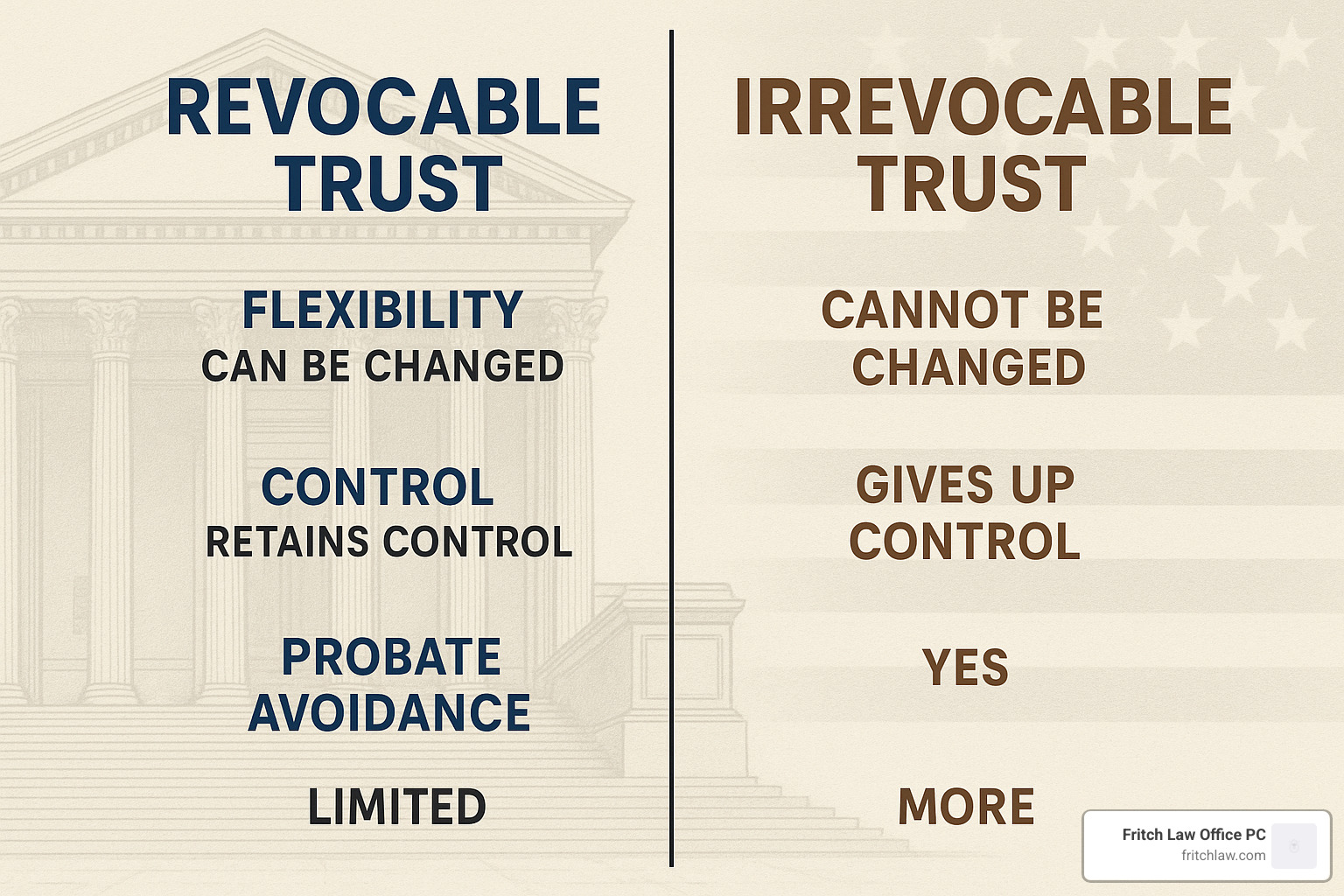
The main distinction between revocable and irrevocable trusts comes down to control versus protection. With a revocable trust, you maintain complete control but gain fewer protections. In contrast, irrevocable trusts offer less flexibility but provide greater protection against creditors and potential tax advantages. It’s like choosing between a convertible (fun, flexible) and an armored car (less convenient, but more secure).
When your assets enter your revocable trust, they technically belong to the trust, but practically speaking, nothing changes in how you use or enjoy them. Your checking account, home, and investments continue working exactly as before – just with different paperwork behind them.
Major Benefits & Drawbacks
The beauty of a revocable trust shines through in several key advantages. Probate avoidance stands as perhaps the biggest benefit – assets properly titled in your trust simply bypass the court-supervised probate process, saving your loved ones time, money, and public scrutiny.
Your family will also appreciate the privacy protection a trust provides. Unlike wills that become public record during probate, your trust distributions remain private family business – nobody needs to know who received what or how much.
Incapacity planning is another crucial benefit that many people overlook. If you become unable to manage your affairs, your designated successor trustee can step in seamlessly, without court intervention or guardianship proceedings.
Of course, revocable trusts aren’t perfect. Since you maintain control, these assets remain vulnerable to your creditors – there’s no asset protection benefit. Similarly, there are no estate tax advantages because the assets are still considered part of your taxable estate.
The initial setup costs typically run higher than a simple will, and there’s some ongoing maintenance required to ensure new assets are properly titled in the trust’s name. The paperwork can feel a bit more complex at first, but most people quickly adjust to the routine.
Who Should Consider One?
You don’t need to be wealthy to benefit from a revocable trust. At Fritch Law Office PC, we’ve found that certain life situations make them particularly valuable:
Homeowners almost always benefit from a trust, especially if you own property in multiple states. Without a trust, your family might face separate probate proceedings in each state where you own real estate – a costly and time-consuming headache.
Blended families find trusts incredibly helpful for creating clear instructions in complex family dynamics. You can specify exactly how you want assets distributed among current spouses, children from previous marriages, and other loved ones.
If you have privacy concerns, a trust keeps your financial affairs out of public records. For those with special needs dependents, trusts can include specialized provisions that protect government benefits while providing supplemental support.
Business owners particularly benefit from the smooth succession planning a trust provides. Your business can continue operating without interruption, even if you become incapacitated or pass away.
In our experience working with families throughout Indiana, anyone with assets valued over $100,000 or who owns real estate typically finds that the benefits of a revocable trust outweigh the costs. The peace of mind alone – knowing your loved ones won’t face probate court during an already difficult time – makes the investment worthwhile for many of our clients.
How Much Does a Revocable Trust Cost in 2024?
The question of how much does a revocable trust cost doesn’t have a one-size-fits-all answer. In 2024, costs range dramatically from around $100 for basic DIY forms to upwards of $10,000 for complex attorney-prepared trusts for high-net-worth individuals. Here in Indiana, most families find themselves somewhere in the middle of this spectrum.
Your chosen approach significantly impacts what you’ll pay. DIY platforms offer basic forms starting around $100-$200, though they provide no legal guidance. Digital services with some support typically run $400-$1,000, while hybrid services combining online drafting with attorney review fall in the $800-$1,500 range. For full-service legal assistance, attorney-prepared trusts typically cost $1,500-$4,000 for standard situations.
Average Setup Costs: DIY to Attorney
When exploring how much does a revocable trust cost, understanding the different options helps you make an informed choice based on your needs and budget.
At the lower end, DIY online services cost between $100-$600. While affordable, these basic templates offer limited customization and no guidance on proper funding. They’re best suited for very simple situations where legal complexities are minimal.
Digital trustmaking services step things up a bit at $400-$1,000. These provide more comprehensive documents and some customer support, though attorney review is often an add-on cost. They represent a middle ground for those with straightforward needs but who want more support than pure DIY options.
Attorney-prepared trusts typically range from $1,500-$4,000 and include personalized legal advice custom to your specific situation. Most importantly, an attorney will guide you through properly funding your trust—a critical step many DIY approaches overlook. These packages often include additional estate planning documents like powers of attorney and healthcare directives.
For complex estates involving multiple properties, business interests, or special planning needs, attorney fees may reach $5,000-$10,000+. These comprehensive packages address sophisticated planning concerns and provide thorough protection.
Here in Jasper, Indiana, most families we work with invest between $1,500-$3,000 for a complete revocable trust package with all the necessary supporting documents.
Factors That Influence the Price Tag
Several key elements affect how much a revocable trust costs:
Estate complexity naturally drives costs higher—more assets, especially varied types, require more detailed planning. Similarly, having numerous beneficiaries or complex distribution schemes increases drafting time and complexity.
Real estate holdings often require separate deed preparation and recording for each property, while transferring business interests typically demands additional specialized documentation.
Geographic location plays a significant role too. Metropolitan areas generally have higher legal fees than rural areas—clients in Jasper typically pay about 20-30% less than those in Indianapolis for comparable services.
Couples usually pay 20-50% more than individuals, depending on the provider, as their planning needs are more complex. Attorney experience also factors in, with more seasoned estate planning attorneys generally commanding higher rates.
Finally, additional documents like pour-over wills, powers of attorney, and healthcare directives add to the total cost, though they’re essential components of a complete estate plan.
Hidden Fees & Extra Charges
When budgeting for your trust, be mindful of potential hidden costs that might not appear in the initial quote:

Property recording fees typically run $50-$200 per property deed, depending on your local recording office. Notary fees range from $2-$20 per signature, though many attorneys include this service in their package.
Future changes aren’t free either—amendments usually cost about 20-30% of the original drafting fee when using an attorney. Digital services often charge annual subscription renewal fees of $39-$199 for document updates and storage.
Some attorneys charge separately for help funding the trust (transferring assets into it), and additional copies of trust certification documents may incur fees of $25-$50 each.
At Fritch Law Office PC, we believe in transparent pricing. We clearly outline all potential costs before you commit, helping you make fully informed decisions about your estate planning investment. This approach has built trust with our clients throughout Jasper and the surrounding communities for decades.
For more information about trust costs, you might find our articles on average cost for a living trust and estate planning attorney fees helpful in your planning process. For a comprehensive overview of trust costs across different service types, check out LegalZoom’s guide on the average cost to prepare a living trust.
Beyond Drafting: Funding & Ongoing Maintenance Expenses
Once you’ve signed your trust documents, the real work begins. Creating the trust is just the first step—bringing it to life requires “funding” it by transferring your assets into the trust’s name. This crucial process comes with its own set of costs that many people don’t anticipate when asking how much does a revocable trust cost.
Funding Your Trust—What It Really Costs
Funding involves changing asset ownership from your individual name to your trust’s name. Think of it as moving your belongings into a new house—everything needs a new address. The costs vary significantly by asset type:
Real estate typically costs $350-$2,000+ per property to transfer. This includes deed preparation, county recording fees, and sometimes title company involvement. I’ve seen clients surprised by these expenses, especially when they own multiple properties.
Banking and investment accounts usually involve minimal direct costs but require your time and attention. You’ll need to visit financial institutions, complete new signature cards, and potentially steer account changes. While the dollar cost is low, the time investment can be substantial.

Business interests often involve the highest funding costs, ranging from $500-$3,000+. Transferring LLC or corporation ownership requires careful documentation, operating agreement amendments, and state filing fees. The complexity here often justifies professional assistance.
Personal property transfers are typically the simplest, requiring minimal cost through an assignment document. Vehicle transfers involve DMV fees and paperwork, but are generally straightforward.
At Fritch Law Office, we’ve found that proper funding guidance makes all the difference. Many attorneys charge separately for funding services at hourly rates of $200-$500, but we include funding guidance in our comprehensive packages because we know making your trust actually work.
Long-Term Maintenance & Amendment Costs
A trust is a living document that needs regular attention as your life evolves. The ongoing costs depend largely on how you manage your trust:
If you serve as your own trustee, ongoing costs are minimal—primarily amendment fees when life changes occur. Self-administration keeps costs down but requires you to stay organized and attentive to trust requirements.
Professional trustee services cost more, typically 0.5-1.5% of trust assets annually. Smaller trusts generally pay higher percentage rates, while larger trusts benefit from economies of scale. These fees provide professional management but add to your overall trust expense.
Digital service subscriptions range from free to $199 annually, offering document updates and amendment capabilities. These services provide convenience but may lack personalized guidance.
Attorney amendments typically cost 20-30% of your original drafting fee. A simple beneficiary change costs less than a complete trust overhaul. In our practice, we’ve helped clients through countless life changes—marriages, divorces, births, and relocations—each requiring trust updates.
Trust settlement costs, which occur after your passing, typically range from less than 1% to 5% of trust assets. These include trustee fees, attorney assistance with distributions, and accounting services.
When comparing these ongoing costs to probate expenses (which typically run 3-7% of estate value), most clients find that trusts offer significant long-term savings. While the initial investment is higher, the lifetime value becomes clear when you consider the full picture of how much does a revocable trust cost over time.
A properly funded and maintained trust provides peace of mind that’s difficult to put a price tag on—knowing your loved ones won’t face court proceedings during an already difficult time is invaluable.
How to Cut the Cost of Your Revocable Trust Without Cutting Corners
Creating a revocable trust doesn’t mean emptying your savings account. With some strategic planning, you can establish a solid estate plan without unnecessary expenses. At Fritch Law Office PC, we’ve helped countless Indiana families find that sweet spot between affordability and effectiveness.
Think of trust creation like building a house—you want quality materials and skilled craftsmanship, but that doesn’t mean you can’t be smart about your budget. Here are some practical ways to manage how much does a revocable trust cost while still getting the protection you need:
Start by comparison shopping. Just as you would with any significant purchase, get quotes from multiple attorneys to understand the range of fees and services in your area. When speaking with attorneys, ask for flat-fee arrangements rather than hourly billing. This approach gives you cost certainty and eliminates the worry about the clock ticking during every phone call or email.
Many of our clients have found success with a hybrid approach. You might use online services for initial drafting, then have an experienced attorney review and refine the documents. This combines affordability with professional oversight. Similarly, look for attorneys who offer “unbundled” legal services, where you pay only for specific tasks rather than comprehensive representation.
After receiving proper guidance, consider handling some of the trust funding yourself. While the legal documents require expertise, you can often transfer bank accounts and some other assets into your trust without paying an attorney to do it for you. This hands-on approach can significantly reduce how much does a revocable trust cost overall.

Before meeting with your attorney, gather all necessary information about your assets, beneficiaries, and estate planning goals. This preparation reduces the time your attorney needs to spend collecting basic information, which translates to lower costs for you. Many attorneys, including our team at Fritch Law Office PC, offer package deals that include trusts, wills, and powers of attorney at a better value than purchasing each document separately.
Is Paying More for an Attorney Worth It?
When comparing DIY options to attorney-prepared trusts, it’s important to consider value rather than just price. While online services might advertise trusts for a few hundred dollars, they often can’t provide the personalized guidance that ensures your trust actually works when your family needs it most.
For complex estates, professional guidance is particularly valuable. If you own multiple properties, have a business, or possess substantial assets, an experienced attorney can help you avoid costly mistakes that might not become apparent until it’s too late to fix them. Similarly, if you own property in multiple states, an attorney can steer the different rules that apply in each jurisdiction.
How much does a revocable trust cost becomes less important when you consider what’s at stake. Special family situations—like providing for a child with special needs or navigating blended family dynamics—require carefully crafted provisions that generic online forms simply can’t address adequately.
Perhaps the most significant benefit of working with an attorney is peace of mind. Knowing your documents are legally sound and properly executed provides reassurance that your wishes will be honored and your loved ones protected. At Fritch Law Office PC, we see our role not just as document creators but as guides through the entire estate planning journey, including the critical step of properly funding your trust.
Budget-Friendly Alternatives to Consider
If you’re not quite ready for a full revocable trust, several alternatives can address some estate planning needs at a lower cost:
An improved will with testamentary trust provisions can handle many concerns, though it won’t avoid probate. In Indiana, transfer-on-death deeds allow real estate to transfer outside of probate without requiring a trust, making them a useful tool for many homeowners.
For financial accounts, consider payable-on-death designations, which allow bank and investment accounts to transfer directly to named beneficiaries. Similarly, joint ownership with rights of survivorship can avoid probate for certain assets, though this approach comes with its own considerations regarding control and potential liability.
Don’t overlook the power of proper beneficiary designations on life insurance policies, retirement accounts, and similar assets. These designations allow assets to pass outside of probate directly to your chosen beneficiaries.
While these alternatives may require a smaller initial investment than a comprehensive revocable trust, it’s important to understand their limitations. They don’t provide the incapacity planning benefits of a revocable trust, nor do they offer the same level of comprehensive asset management. Think of them as stepping stones that can be part of a staged approach to complete estate planning, rather than permanent substitutes for a proper trust.
At Fritch Law Office PC, we’re committed to helping you find the right solution for your specific situation and budget. We offer resources like our guides on average cost for a living trust and estate planning attorney fees to help you make informed decisions about this important investment in your family’s future.
Frequently Asked Questions About How Much Does a Revocable Trust Cost
How long does it take to create and fund a revocable trust?
Creating a revocable trust isn’t an overnight process, but it’s not as time-consuming as many people fear. From our experience working with Indiana families, most trusts take about 2-4 weeks from your first meeting to having signed documents in hand.
The journey typically follows this path:
You’ll start with an initial consultation (usually 1-2 hours) where we discuss your family situation and goals. After gathering your information, we’ll spend about 1-2 weeks drafting your custom documents. You’ll then have a review period of 3-7 days to look everything over before we finalize anything. The signing appointment itself only takes 1-2 hours.
But remember—creating the trust is just the beginning. Funding your trust (moving assets into it) is where the real work happens:
Bank accounts typically take 1-2 weeks to transfer, while investment accounts might need 2-4 weeks. Real estate transfers usually require 3-6 weeks to complete all paperwork and recordings. Business interests are the most time-intensive, often taking 1-3 months to properly transfer.
At Fritch Law Office PC, we don’t just hand you documents and wish you luck. We provide detailed guidance, templates, and instructions to help make the funding process as smooth as possible.
Can I update or revoke my trust, and what will it cost?
One of the beautiful things about a revocable trust is right in the name—it’s revocable! You can update or completely dissolve it anytime during your lifetime.
When it comes to how much does a revocable trust cost to update, it really depends on what you’re changing:
Making a minor amendment, like changing a beneficiary or trustee, typically costs between $300-$600. More substantial amendments that rework your distribution plans might run $700-$1,200. If you need a complete overhaul, a full restatement usually costs about 50-75% of your original trust price. And if you want to revoke the trust entirely, expect to pay around $300-$500 for the proper revocation document.
If you’re using an online service with a subscription model, you might pay an annual fee ($39-$199) that includes unlimited amendments. This can be a good value if your life circumstances change frequently.
Most of our clients at Fritch Law Office PC end up amending their trusts at least once every 5-10 years as children grow up, relationships change, or financial situations evolve.
How does the cost of a revocable trust compare to drafting only a will?
This is perhaps the most important financial question to consider. While a trust costs more upfront, the long-term math often tells a different story.
Let’s look at the initial document costs: A simple will typically runs $300-$1,000, while a comprehensive revocable trust package usually costs $1,500-$4,000. That’s a significant difference upfront.
But the real comparison comes after you’re gone. With just a will, your estate will likely go through probate—a court process that typically costs between 3-7% of your estate’s value, plus court costs and attorney fees. A properly funded trust, however, avoids probate entirely, with settlement costs usually around just 1-2% of trust assets.
To put this in perspective: For a $500,000 estate, will-based probate might cost your heirs $15,000-$35,000 in fees and expenses. Trust settlement for the same estate might only cost $5,000-$10,000.
Beyond just money, there’s also the time factor. Probate in Indiana typically takes 9-18 months to complete, while trust administration can often be wrapped up in 3-6 months. That means your loved ones receive their inheritance much sooner.
It’s worth noting that Indiana does offer streamlined probate for smaller estates (under $100,000 in certain circumstances), which can make wills more cost-effective if you have minimal assets.
When clients ask us about how much does a revocable trust cost compared to a will, we always encourage them to think beyond the initial price tag and consider the full financial picture—including what their loved ones will experience after they’re gone.
Conclusion
When weighing how much does a revocable trust cost, it’s important to look beyond just the initial price tag. A well-crafted and properly funded revocable trust delivers long-term benefits that typically far outweigh your upfront investment.
Think of your revocable trust as part of a comprehensive estate plan rather than a standalone document. It works alongside your other planning tools to create a seamless system for managing your assets during your lifetime and distributing them after you’re gone. The peace of mind this brings—knowing your loved ones won’t face the stress and expense of probate—is truly invaluable.
At Fritch Law Office PC, we’ve guided countless Indiana families through this process. Our clients consistently tell us that the clarity and confidence they gain from having a proper estate plan in place is worth every penny invested. The trust becomes the cornerstone of their legacy planning, ensuring their wishes are carried out exactly as intended.
While creating a trust involves some upfront costs, it typically saves money in the long run by:
- Avoiding probate fees that can run 3-7% of your estate’s value
- Preventing costly court proceedings if you become incapacitated
- Reducing potential conflicts among beneficiaries
- Minimizing professional fees during the estate settlement process
- Protecting your privacy and keeping your affairs out of public record
The value of working with an experienced lawyer goes beyond just document preparation. At Fritch Law Office PC, we take the time to understand your unique family situation, explain complex concepts in plain language, and provide ongoing support as your life and circumstances evolve.
Ready to take the next step in protecting your family’s future? Contact Fritch Law Office PC today to schedule a consultation. We’ll help you create a personalized estate plan that addresses your specific concerns while respecting your budget. Our transparent pricing and flexible options make quality estate planning accessible to families throughout Jasper and surrounding Indiana communities.

A revocable trust isn’t just a legal document—it’s an investment in your family’s security and your own peace of mind. While the cost may seem significant today, the protection and clarity it provides will benefit your loved ones for generations to come.