
Navigating Your Workplace Rights and Obligations
Employment law services encompass all legal assistance related to workplace matters, protecting both employees and employers. When facing workplace issues, understanding your options is crucial.
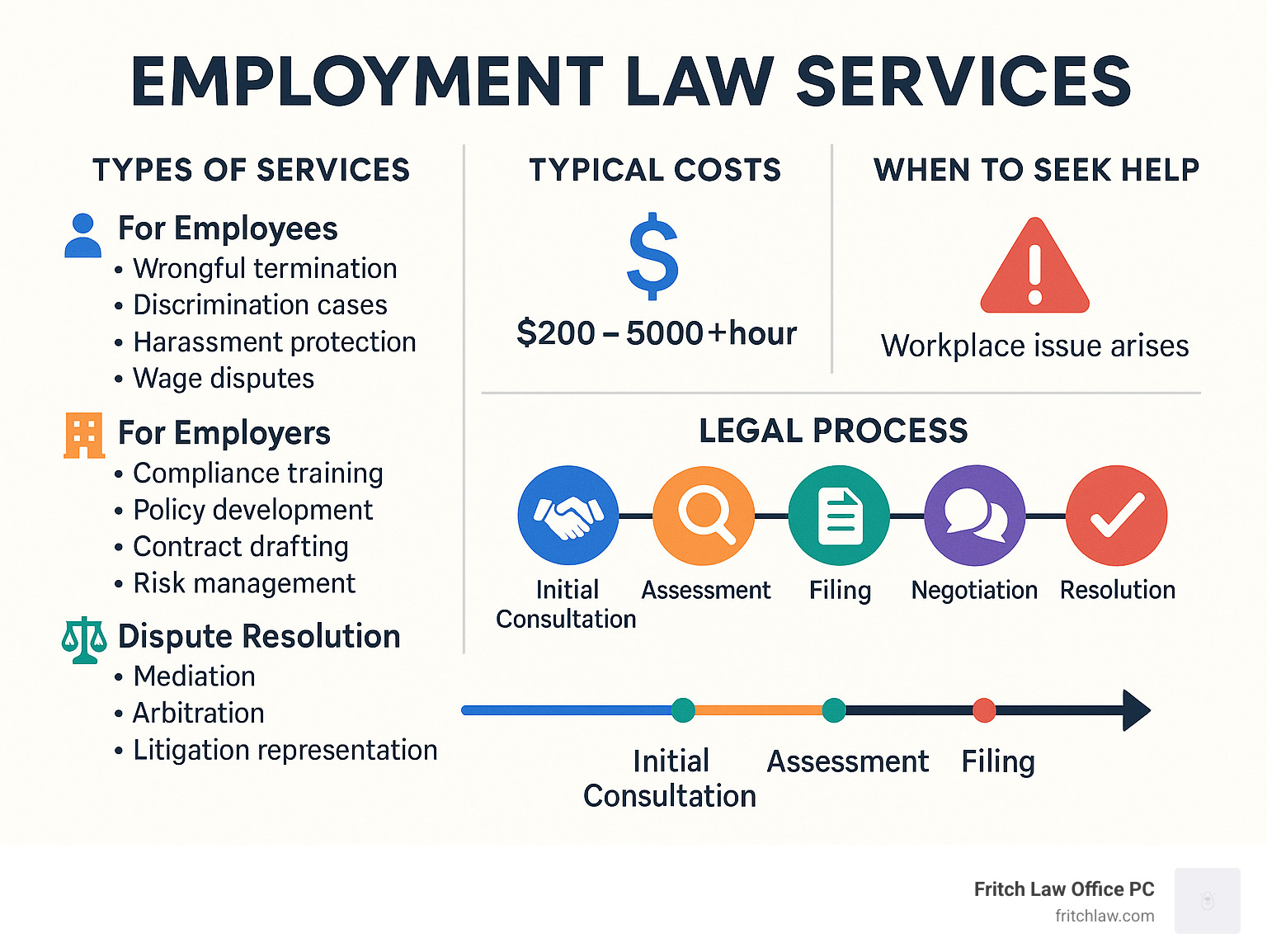
Types of Employment Law Services:
* For Employees: Wrongful termination claims, discrimination cases, harassment protection, wage disputes
* For Employers: Compliance training, policy development, contract drafting, risk management
* Dispute Resolution: Mediation, arbitration, litigation representation
* Preventive Services: HR audits, handbook creation, compliance training
The workplace should be a safe environment where rights are respected and obligations are clear. Unfortunately, many people face discrimination, harassment, wage theft, or other violations that require professional legal intervention.
Whether you’re an employee whose rights have been violated or an employer seeking to maintain compliance, employment law services provide the guidance needed to steer complex legal landscapes.
I’m David Fritch, with extensive experience helping clients steer employment law services through my practice at Fritch Law Office PC, where I combine legal expertise with practical business knowledge to resolve workplace disputes efficiently.
Employment law services terms to remember:
– employee rights attorney
– unfair dismissal claim
– labor law attorney
What You’ll Learn
In this comprehensive guide, we’ll cover the essential aspects of employment law services that both employees and employers need to understand. You’ll learn:
- The scope of employment law and how it affects your workplace rights and responsibilities
- Key workplace violations and how to identify them
- When to seek professional legal help versus handling issues internally
- How to choose the right legal support for your specific situation
- The process of filing and proving an employment law case
- Critical deadlines and evidence requirements that can make or break your case
By the end of this guide, you’ll have a clearer understanding of when and how to engage with employment law services in Indiana and beyond.
Understanding Employment Law Services
The workplace can be a complicated legal landscape to steer. Employment law services are the support systems that help both workers and businesses understand their rights and responsibilities under the maze of regulations that govern our work lives.
Think of employment law as operating on three critical levels that often overlap and interact:
Federal laws create the foundation of workplace protections across America—things like the Fair Labor Standards Act setting minimum wage standards, the Americans with Disabilities Act ensuring reasonable accommodations, and Title VII prohibiting discrimination based on protected characteristics.
State laws in Indiana sometimes provide additional protections beyond federal requirements, creating another layer of compliance considerations for employers and rights for employees.
Local ordinances in certain cities and counties might add even more specific requirements, particularly around issues like paid leave or hiring practices.
At Fritch Law Office PC, we maintain active membership in professional networks like the Employment Law Alliance, which helps us deliver consistent, up-to-date legal guidance as employment laws continuously evolve. The scientific research on workplace compliance confirms that staying current with these changes is essential for both employers and employees.
“The workplace should be a safe environment where everyone is treated fairly,” is something I often remind clients. “Unfortunately, that’s not always the reality—which is precisely why employment law services exist.”
Employment Law Services for Employees
When your workplace rights have been violated, knowing where to turn can make all the difference. Employment law services for employees focus on protecting your dignity, fair treatment, and financial security.
Workers come to us when facing serious challenges like wrongful termination, where they’ve been fired for reasons that violate the law. This might include being fired after reporting unsafe conditions (whistleblower retaliation), after requesting a disability accommodation, or based on discrimination.
We also help employees steer hostile work environments, sexual harassment situations, and instances of wage theft—when employers don’t pay overtime, force work “off the clock,” or misclassify workers to avoid paying benefits.
Many clients initially feel powerless against their employers. One recently told me, “I never thought I could stand up to a company that size, but having an experienced attorney by my side gave me the confidence to seek justice.” This change from feeling helpless to empowered is why I find this work so rewarding.
If you’re facing workplace issues, learning more about your specific protections is crucial. Our resource on employee rights attorneys provides valuable insights to help you understand your options.
Employment Law Services for Employers
Smart business owners know that staying compliant with employment laws isn’t just about avoiding lawsuits—it’s about creating workplaces where people want to stay and contribute their best work. Employment law services for employers are investments in both protection and productivity.
For businesses throughout Jasper and across Indiana, we provide practical guidance on developing employee handbooks that clearly communicate expectations while complying with current laws. We conduct thorough HR audits to identify potential issues before they become expensive problems.
Policy drafting is another crucial service, helping businesses create clear, legally-sound procedures for everything from harassment reporting to time-off requests. These written policies protect both the business and its employees by establishing consistent standards.
Risk mitigation strategies help employers steer tricky situations like performance management, workplace investigations, and termination decisions in ways that reduce legal exposure while maintaining workplace morale.
“I sleep better at night knowing our policies have been reviewed by someone who understands the law,” a local business owner recently shared. “It’s like insurance we hope we never need, but are grateful to have.”
For businesses looking to build stronger foundations for their employment practices, our practice areas page outlines our comprehensive approach to employer representation.
The relationship between employers and employees works best when both sides understand their rights and responsibilities. At Fritch Law Office PC, we’re committed to fostering workplaces where legal compliance and mutual respect go hand in hand.
Key Workplace Violations & How to Spot Them
Navigating workplace issues starts with knowing what’s not okay. Whether you’re an employee who feels something’s off or an employer wanting to stay on the right side of the law, understanding common violations is your first step toward resolution.

When I talk with clients at Fritch Law Office PC, many aren’t sure if what they’ve experienced crosses the legal line. Let’s clear that up by looking at the most common workplace issues that might require employment law services.
Discrimination happens when employees face unfair treatment based on protected characteristics. This might look like a pattern of only promoting certain types of people, or suddenly receiving negative reviews after revealing a pregnancy. The law protects against discrimination based on race and color (including jokes or slurs targeting certain groups), gender (including pregnancy), age (targeting workers 40+), disability (including failure to provide reasonable accommodations), religion (not respecting religious practices), and national origin (treating people differently based on accent or ethnicity).
Harassment creates a work environment that feels hostile or threatening. This includes sexual harassment like unwanted advances or comments, a generally hostile work environment with pervasive offensive conduct, or quid pro quo situations where job benefits are tied to submitting to unwelcome behavior. One client told me, “I thought I just had to put up with it to keep my job,” but no one should feel that way at work.
Retaliation occurs when you’re punished for doing something legally protected, like reporting discrimination or requesting overtime. Watch for sudden schedule changes, increased scrutiny, or even termination shortly after speaking up. The law specifically prohibits this kind of pushback against employees who assert their rights.
Wage Theft & Misclassification Red Flags
Wage theft is surprisingly common and takes many forms. Your paycheck might be lighter than it should be if you’re experiencing unpaid overtime (not receiving time-and-a-half for hours over 40 in a week), minimum wage violations (being paid less than $7.25/hour federally), or being asked to work off-the-clock before or after your shift.
Misclassification is another frequent issue I see. Many workers are wrongly labeled as exempt from overtime or as independent contractors when they legally qualify for overtime protection. You might be misclassified if your salary is below $684/week ($35,568 annually), your job doesn’t involve much independent judgment, or you do similar work to non-exempt colleagues.
I recently helped a day-rate worker who was being shortchanged. He was paid $200 per day regardless of hours worked. For a 50-hour week, he should have received $1,560 after overtime calculations, not just $1,000. His employer was surprised but ultimately corrected the issue.
Other wage violations include illegal deductions that drop your pay below minimum wage, tip theft by managers or owners, and withholding final paychecks after you leave a job. If any of these sound familiar, consider seeking free employment advice to understand your options.
Common Discrimination & Harassment Claims
In my practice, certain patterns emerge across different types of discrimination claims:
With race discrimination, I often see different disciplinary standards applied to different racial groups, offensive comments being tolerated, or qualified people being passed over for opportunities based on race.
Gender discrimination frequently involves pay gaps between men and women doing the same job, pregnancy-related discrimination, or different standards for promotion. Sexual harassment falls under this umbrella too.
Age discrimination shows up as comments about wanting “new blood” or “fresh perspectives,” older workers being targeted for layoffs, or experienced employees being overlooked for advancement opportunities despite strong qualifications.
For disability discrimination, common issues include denying reasonable accommodations, asking intrusive questions about disabilities during interviews, or termination after an employee discloses a health condition.
Time is critical with discrimination claims. The EEOC typically gives you just 180 days to file (extended to 300 days in some states). Miss this window, and you might lose your right to pursue the claim altogether. This is why prompt action and timely employment law services are so important.
Identifying these violations is the first step toward addressing them. Whether you’re looking to protect yourself as an employee or ensure compliance as an employer, understanding these common issues helps create healthier, fairer workplaces for everyone.
Employee vs Employer: Choosing the Right Legal Support
The type of employment law services you need depends significantly on whether you’re an employee or employer. Each side faces different challenges and requires custom support to steer workplace issues effectively.

When I meet with clients at Fritch Law Office PC, one of the first things we discuss is how legal services are structured differently depending on which side of the employment relationship you stand on. Understanding these differences helps you make informed decisions about getting the help you need.
For Employees:
If you’re an employee seeking justice in the workplace, you’ll find several paths to affordable legal help.
Contingency fee arrangements are perhaps the most accessible option for many workers. These “no win, no fee” structures mean you don’t pay attorney fees unless your case succeeds. Typically, the attorney receives a percentage (usually 30-40%) of any settlement or judgment. This approach removes financial barriers to justice when you’ve been wronged.
I’ve seen how limited scope representation can be a lifeline for employees with specific needs. Rather than hiring an attorney for full representation, you might pay for targeted help with document review or coaching through self-representation. This approach keeps costs manageable while still providing expert guidance.
Subscription legal plans like LegalShield have become increasingly popular, offering employment law advice starting at $26.95/month. These plans provide a budget-friendly way to access attorney advice without breaking the bank.
Almost all employment attorneys offer free consultations to evaluate your case. Take advantage of these opportunities to understand your rights without financial commitment.
One important point many employees don’t realize: “Employees retain the right to sue for unpaid wages or overtime even if they signed a waiver, unless it is explicitly approved by a court or the Department of Labor.” This protection ensures access to justice even when employers try to limit your legal options.
For Employers:
Business owners and managers typically engage with employment law services through different models designed to provide both protection and predictability.
Many of our business clients prefer retainer arrangements with fixed quarterly or annual fees for unlimited access to advice and document review. These arrangements provide cost certainty and encourage proactive consultation—which often prevents costly problems before they arise.
For specific needs, project-based fees offer clarity and transparency. Whether you need an employee handbook created or policies updated to reflect new laws, flat fees give you budget predictability.
Hourly billing remains common for litigation or complex matters where the scope is difficult to predict. While less predictable, this model ensures you only pay for the time actually needed to resolve your matter.
Some businesses benefit from comprehensive HR support packages that combine legal and HR services for full-spectrum workplace management. These integrated approaches can be particularly valuable for growing companies without in-house HR expertise.
At Fritch Law Office PC, we tailor our service models to fit your specific situation and budget—whether you’re an employee seeking justice or an employer working to maintain compliance.
Comparing Fee Structures
Understanding different fee structures helps you choose the right employment law services for your situation:
Hourly Fees typically range from $150-$500 per hour depending on location and attorney experience. They work best for complex cases with uncertain scope or employers with occasional needs. To manage costs, ask for regular billing updates and consider requesting caps on specific tasks.
Flat Fees provide welcome predictability for document drafting, policy reviews, and specific procedures. The main advantage is knowing exactly what you’ll pay with no surprises. Always clarify what’s included and what might trigger additional fees.
Contingency Fees (typically 30-40% of recovery plus costs) make legal help accessible for employees with strong cases but limited resources. Before proceeding, discuss exactly how costs are handled whether you win or lose your case.
Subscription/Retainer Models with monthly or quarterly fees work wonderfully for employers seeking preventative advice and regular document review. When considering these options, ensure the retainer covers the services you’ll need most frequently.
As one client told me after choosing a fixed-fee service, “I finally have budget certainty for our legal needs—no more surprise bills that throw off our quarterly projections.” This predictability is especially valuable for small businesses and individuals carefully watching expenses.
Alternative Dispute Resolution Options
Not all employment issues need to end up in court. Alternative dispute resolution (ADR) methods can save time, money, and stress while still achieving fair outcomes.
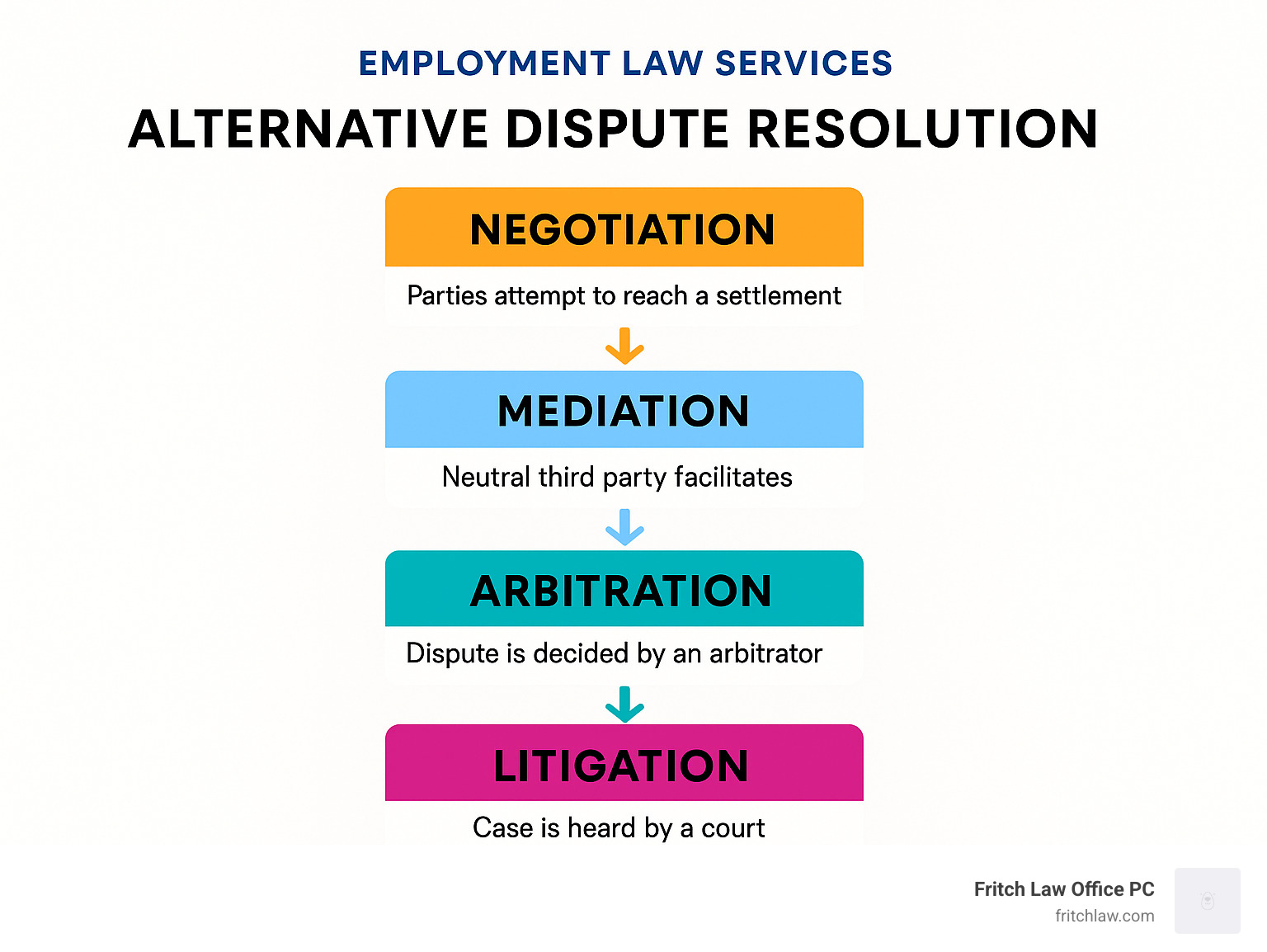
Mediation brings both sides together with a neutral third party who helps facilitate a voluntary agreement. It’s typically faster and less expensive than litigation, preserves relationships, and allows for creative solutions that courts might not offer. The process remains non-binding unless both parties agree to terms.
Arbitration is more formal than mediation but less formal than court proceedings. An arbitrator (essentially a private judge) renders a binding decision after hearing both sides. Many employment contracts require arbitration for disputes. While efficient, arbitration can limit findy rights and appeal options.
Settlement Agreements are negotiated resolutions that avoid formal proceedings altogether. These agreements often include financial compensation and sometimes non-monetary terms like reference letters or policy changes. They frequently contain confidentiality provisions and release of claims. I always emphasize to clients the importance of having an attorney review these agreements before signing.
As one relieved client shared after successful mediation, “We resolved in four hours what might have taken two years in court—and I could finally move forward with my life.” At Fritch Law Office PC, we guide clients through these alternative processes to find efficient resolutions when appropriate.
The right approach depends on your specific situation, goals, and relationship with the other party. During our initial consultation, we’ll discuss which path makes the most sense for your unique circumstances.
How to File, Prove, and Win Your Case
Taking legal action for workplace violations can feel overwhelming, but understanding the process makes it manageable. Whether you’re dealing with discrimination, unpaid wages, or wrongful termination, knowing how to steer the system is crucial to your success.
When clients come to me with employment issues, I break down the process into clear steps that anyone can follow. Let’s walk through how to properly file your claim, gather compelling evidence, and meet those all-important deadlines.
Filing Your Claim
The path to justice begins differently depending on your specific workplace issue:
For discrimination or harassment claims, you’ll typically start with the Equal Employment Opportunity Commission (EEOC). You must file your Charge of Discrimination within 180 days of the violation, though this extends to 300 days in some states. After investigating, the EEOC may attempt to resolve your case through conciliation. If unsuccessful, you’ll receive a “right to sue” letter, giving you 90 days to file in court.
“Many people don’t realize they have to file with the EEOC before going to court for discrimination claims,” I often tell clients. “Missing this step can get your case dismissed regardless of its merits.”
For wage and hour violations, you can file a complaint with the Department of Labor’s Wage and Hour Division. Indiana residents may also file with our state Department of Labor. Unlike discrimination claims, many wage issues like FLSA violations can be taken directly to court without administrative exhaustion.
| Issue Type | Federal Deadline | Indiana Deadline | Notes |
|---|---|---|---|
| Discrimination (Title VII) | 180-300 days to EEOC | 180 days to ICRC | 90 days to sue after right-to-sue letter |
| FLSA Wage Claims | 2 years (3 for willful) | 2 years (3 for willful) | Direct to court filing allowed |
| FMLA Violations | 2 years (3 for willful) | Same as federal | No administrative filing required |
| Wrongful Termination | Varies by claim type | Varies by claim type | At-will employment exceptions |
These deadlines are strict – missing them typically means losing your right to pursue your claim, no matter how strong your case may be. That’s why seeking employment law services promptly is so important.
Gathering Winning Evidence
The strength of your case often comes down to the quality of your evidence. I’ve seen strong claims fall apart due to lack of documentation, and seemingly difficult cases prevail because the client kept detailed records.
Good documentation starts before you ever speak to a lawyer. Keep copies of your pay stubs, time records, and any communications about your work conditions. Screenshot text messages and emails that relate to your issue. If you’re experiencing discrimination or harassment, keep a detailed journal noting dates, times, what happened, who was present, and how you responded.
“Your contemporaneous notes can be powerful evidence,” I tell clients. “A journal entry you wrote the day harassment occurred carries much more weight than trying to recall details months later.”
For wage claims, track your actual hours worked, including any off-the-clock work your employer requested. Compare this to your pay stubs to identify discrepancies. For discrimination claims, note how others in similar positions but different protected classes are treated compared to you.
Other valuable evidence includes:
– Performance reviews and disciplinary records
– Company handbooks and written policies
– Medical records (for FMLA or ADA claims)
– Witness contact information
– Records of any internal complaints you’ve filed
When clients come to me with organized documentation, we can build much stronger cases. Learn more about building a compelling unfair dismissal claim on our website.
Statutes, Deadlines, and Costs
Understanding the timeline and potential costs helps you make informed decisions about pursuing employment law services.
The clock starts ticking on your claim from the moment the violation occurs. For wage claims under the FLSA, you generally have 2 years (3 years for willful violations) to file. Discrimination claims under Title VII must be filed with the EEOC within 180 days in most cases, though some states extend this to 300 days.
The financial aspect of legal action is naturally a concern for most clients. Here’s what you can typically expect:
Court filing fees start around $400 for federal cases, with state court fees usually being somewhat lower. For employees, many attorneys (including our firm) work on contingency fees, meaning you pay a percentage (typically 30-40%) of your recovery only if you win. This makes legal help accessible regardless of your financial situation.
Other potential costs include expert witness fees ($1,500-$5,000+), deposition expenses ($500-$1,000+ per deposition), and findy costs for document production. During your initial consultation, we’ll discuss these potential expenses so you can make an informed decision.
“The scientific research on statute impact is clear,” notes one legal study from Chambers. “Claims filed closer to the triggering event have significantly higher success rates due to fresher evidence and witness recollections.”
At Fritch Law Office PC, we provide clear guidance on deadlines and costs during your initial consultation. We believe in transparent communication about both the strengths of your case and the practical considerations of pursuing it. Understanding the full picture helps you make the best decision for your specific situation.
Your Employment Law Roadmap: FAQs & Next Steps
When workplace issues arise, you need clear answers and a solid plan. At Fritch Law Office PC, we’ve compiled responses to the questions our clients ask most frequently about employment law services.
What is the deadline to file an employment law claim?
Time limits for employment claims vary significantly, and missing these deadlines can permanently bar your claim:
For discrimination claims under federal law, you must file with the EEOC within 180 days of the discriminatory act. This extends to 300 days in states with their own anti-discrimination laws.
“I didn’t realize there was such a tight window to file my discrimination claim,” one client told us. “I’m so glad I reached out when I did.”
Wage and hour claims follow the FLSA timeline of 2 years from the violation, or 3 years if the violation was willful. Indiana follows these same timeframes.
For FMLA violations, you have 2 years from the violation, extended to 3 years for willful violations.
Breach of contract claims in Indiana typically allow 6 years for written contracts and 2 years for oral agreements.
Special “tolling” rules may sometimes extend these deadlines, such as with continuing violations or when an employer conceals information. However, it’s always wisest to consult with a labor law attorney as soon as possible rather than risking your claim.
How do I know if I need professional employment law services?
For employees, consider seeking professional help when:
Your workplace situation has significantly affected your income, health, or career trajectory. This includes wrongful termination, harassment that HR isn’t addressing, unpaid wages or overtime, denied FMLA leave, or being asked to sign complex agreements like severance packages or non-competes.
“My employer kept saying my overtime complaint was ‘being handled,’ but months went by with no resolution,” shared a former client. “Once I brought in legal representation, they suddenly found a solution within a week.”
For employers, professional employment law services become valuable when:
You’re planning terminations or restructuring, updating company policies, responding to complaints or demand letters, investigating internal allegations, implementing new pay structures, or considering accommodation requests. Preventative legal guidance often saves significant time and money compared to defending claims after they arise.
The potential value of your situation (exceeding $5,000) and the complexity of the issues should guide your decision. When employers have legal representation—and they almost always do—having your own advocate levels the playing field.
What evidence should I collect before calling a lawyer?
Gathering key documentation before your initial consultation helps us evaluate your case more effectively and hit the ground running.
Start with your employment basics: your contract or offer letter, employee handbook, and relevant company policies. These establish the formal relationship and expectations.
For wage issues, collect pay documentation: pay stubs, time records, and any communications about compensation. For performance-related matters, gather evaluation materials: performance reviews, disciplinary notices, and communications about your work.
“I wasn’t sure what would be helpful, so I forwarded every email about my situation,” one client told us. “My attorney was able to spot a pattern I hadn’t even noticed.”
Don’t forget to document names and contact information for witnesses who observed relevant events. Their perspectives can strengthen your case considerably.
For accommodation or leave issues, include medical documentation supporting your requests. And if you’ve kept a journal or notes about problematic incidents, these contemporaneous records can be incredibly valuable.
At Fritch Law Office PC, we provide detailed guidance on evidence gathering during your initial consultation. For more information about what to expect when working with us, visit our frequently asked questions page.
We understand that workplace legal issues can be overwhelming. That’s why we’re committed to providing clear, practical guidance custom to your specific situation. Whether you’re an employee seeking justice or an employer working to maintain compliance, our experienced team is ready to help you steer the complexities of employment law.
Conclusion & Call to Action

When it comes to workplace legal matters, feeling overwhelmed is completely normal. The world of employment law services is filled with deadlines, technical terms, and high stakes—but remember, you don’t have to figure it all out alone.
I’ve seen how employment issues can affect people’s lives and livelihoods. Whether you’re an employee whose rights have been violated or an employer working to create a fair workplace, taking that first step toward resolution can make all the difference.
At Fritch Law Office PC, we believe in making legal help accessible and understandable. Our approach combines solid legal knowledge with real-world practicality—because sometimes you need more than just what the law says; you need to know how it applies to your unique situation in Jasper and throughout Indiana.
The most important lesson I hope you’ll take from this guide is that timing matters tremendously in employment law. Those strict filing deadlines we discussed? They’re non-negotiable in most cases. Missing them can mean losing your right to pursue justice, no matter how strong your case might be.
Documentation is your best friend in these situations. Those emails you saved, the notes you took after uncomfortable conversations, the screenshots of problematic messages—they can make the difference between winning and losing your case. As we often tell clients: if it isn’t written down, it’s much harder to prove it happened.
For employers, I can’t stress enough how much more affordable prevention is than litigation. The cost of having proper policies reviewed, conducting training, or consulting about a difficult employee situation is a fraction of what defending a lawsuit costs—both financially and in terms of company morale and reputation.
When workplace issues first appear, addressing them promptly often leads to simpler, less expensive resolutions. I’ve seen small problems transform into major litigation simply because someone waited too long to seek help.
If you’re facing discrimination, harassment, wage theft, or need guidance on compliance matters, reaching out for professional employment law services isn’t an admission of defeat—it’s a strategic decision to protect what matters. Our personalized approach ensures you get guidance custom to your specific circumstances, not generic advice that might not apply to your situation.
Ready to discuss your employment law concerns? We’re here to help steer whatever challenges you’re facing. Learn more about our approach and how we can assist with your specific employment matters by visiting our comprehensive practice areas page.
Remember: A fair workplace isn’t just a legal requirement—it’s fundamental to human dignity. When that fairness is compromised, employment law services provide the path to restore balance and justice. You deserve nothing less.