Understanding Irrevocable Trusts in Indiana: A Comprehensive Guide
An irrevocable trust Indiana is a legal arrangement where assets are permanently transferred out of your ownership into a trust managed by a separate trustee for the benefit of your chosen beneficiaries. Unlike revocable trusts, these cannot be changed or canceled once established without special circumstances.
Quick Guide to Irrevocable Trusts in Indiana:
| Feature | Description |
|---|---|
| Definition | Legal entity that permanently removes assets from your ownership |
| Primary Benefits | Asset protection, tax advantages, Medicaid planning |
| Key Disadvantage | Loss of control over assets once transferred |
| Legal Requirements | Written document, competent grantor, valid trustee, proper funding |
| Indiana Specifics | No state estate tax; governed under Indiana Code Title 30 |
According to CNBC, only 18% of Americans with estate plans use trusts, yet these powerful tools can provide significant benefits for Indiana residents looking to protect assets, minimize taxes, and plan for long-term care needs.
When to Consider an Irrevocable Trust in Indiana:
- You want to qualify for Medicaid while preserving assets
- You need protection from potential creditors or lawsuits
- You wish to reduce federal estate tax exposure
- You want assets to bypass probate after your death
- You have a beneficiary with special needs
I’m David Fritch, with over 40 years of experience helping Indiana families establish effective estate plans including irrevocable trusts. Throughout my career at Fritch Law Office PC, I’ve guided countless clients through the complexities of irrevocable trust Indiana arrangements to protect their assets and secure their family’s future.
Relevant articles related to irrevocable trust indiana:
– estate planning attorney indiana
– estate planning and probate attorney indiana indianapolis
– estate planning in hamilton county indiana
What Is an Irrevocable Trust?
An irrevocable trust Indiana is a special kind of legal tool that lets you move your assets out of your own name and into the care of a trust. Once you do this, those assets are managed by a trustee—not you—for the people you name as beneficiaries. The most important thing to know? The word “irrevocable” means you can’t just take your assets back or change the rules later on a whim. This decision is meant to last.
Transferring your property or money into an irrevocable trust in Indiana creates a clear line between your personal assets and your trust assets. This separation brings a few big changes:
- Your assets are no longer part of your personal estate. This means those items aren’t counted as yours for things like estate taxes or qualifying for Medicaid.
- You give up direct control. You can’t decide to sell or spend those assets, because your trustee is now in charge.
- An independent trustee manages everything. This person or company is legally bound to follow the rules you set up in your trust document.
- Probate is usually avoided. When you pass away, assets in the trust go straight to your chosen beneficiaries, skipping the long (and often public) probate process.
- Asset protection kicks in. In many cases, assets in an irrevocable trust are better shielded from creditors, lawsuits, or even certain taxes.
Indiana law is clear on this point. As Indiana Code § 30-4-3-6(a) explains, “The trustee has a duty to administer a trust according to the terms of the trust.” In plain English, once your trust is set up, you set the rules—and the trustee must stick to them.
How an Irrevocable Trust Works
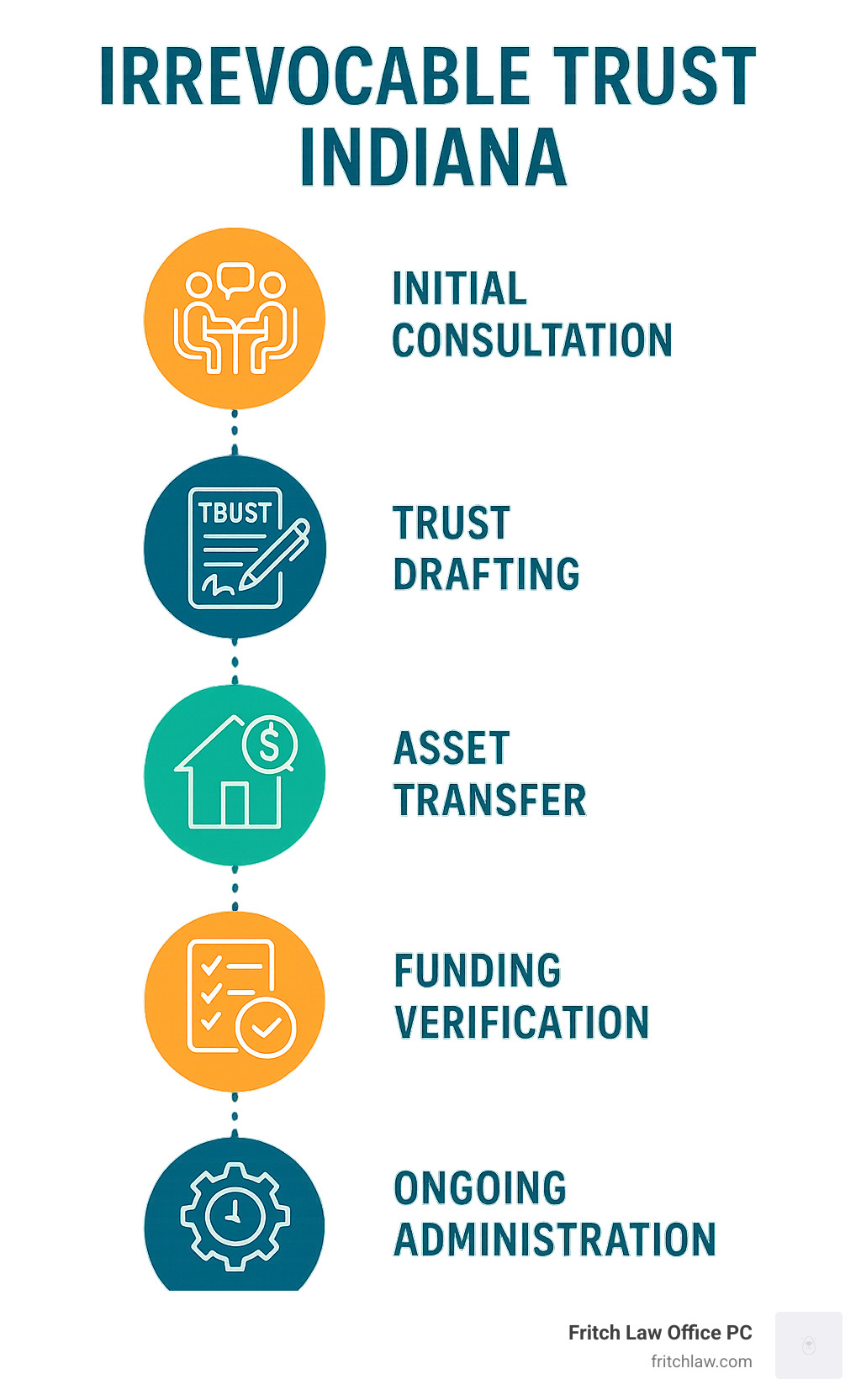
Setting up an irrevocable trust Indiana is a step-by-step process, but it all starts with some careful planning and paperwork.
First, you’ll work with an experienced lawyer to draft a trust document. This spells out your wishes, names your beneficiaries, picks a trustee, and sets up all the rules for how the assets should be managed and distributed. It’s important to be crystal clear, because you typically can’t tweak these terms later.
Next comes the asset transfer. You actually move your property, bank accounts, or other valuables into the trust’s name. This might mean retitling a house deed or updating bank paperwork—think of it as “handing over the keys” in a legal sense.
Unlike with a revocable trust (where you might serve as your own trustee), an irrevocable trust in Indiana usually requires you to pick someone else. This independent trustee—whether it’s a trusted friend, family member, or a professional company—manages your assets and carries out your wishes. They have a legal duty to follow your instructions, not their own preferences.
Finally, the trustee’s job is to distribute money or property to your beneficiaries according to the rules you set up. Maybe that’s regular income payments, a lump sum at a certain age, or special instructions for unique family situations.
Here’s a real-life example: A Jasper farm owner wanted to keep his 200-acre property in the family, safe from potential nursing home costs. By moving the land into an irrevocable trust, he set up a plan where his children received income during his lifetime, and the land would eventually pass to them—no matter what happened with his health or creditors.
If you want more details on the basics of estate planning and how irrevocable trust Indiana fits into your big picture, check out More info about estate planning basics.
Setting up an irrevocable trust is a big decision—but for many Hoosiers, it’s a powerful way to protect what matters most.
Irrevocable Trust Indiana vs. Revocable Trust

When it comes to estate planning in Indiana, understanding the difference between a revocable trust and an irrevocable trust Indiana can make all the difference for your peace of mind—and your family’s future. Both types of trusts allow you to manage and pass on your assets privately, but the level of control and protection you get is very different.
Let’s start with control. With a revocable trust, you stay in the driver’s seat. You can change, update, or even cancel it whenever you wish. On the flip side, once you set up an irrevocable trust Indiana, you’re handing over the keys. You permanently transfer assets to the trust and usually can’t change your mind, except in a few rare situations.
The asset protection side is just as important. Revocable trusts don’t protect your assets from creditors or lawsuits—they’re still considered yours. But with an irrevocable trust Indiana, once those assets are in the trust, they’re typically shielded from creditors and legal claims. This can be a lifeline for those in high-risk professions or anyone worried about future liabilities.
Medicaid planning is another crucial difference. Assets in a revocable trust still count against you if you apply for Medicaid, which could make it harder to qualify for help with long-term care. An irrevocable trust Indiana, however, if set up and funded at least five years before applying, can help you qualify while preserving assets for your loved ones.
Tax treatment also varies. Assets in a revocable trust are still part of your taxable estate, but with an irrevocable trust, they’re generally excluded—potentially lowering estate taxes for larger estates.
Here’s a quick comparison to make things crystal clear:
| Feature | Irrevocable Trust Indiana | Revocable Trust |
|---|---|---|
| Control | Assets permanently transferred; limited control | Grantor maintains full control |
| Modification | Generally cannot be changed or revoked | Can be modified or revoked anytime |
| Asset Protection | May protect assets from creditors | No protection from creditors |
| Medicaid Planning | Can help qualify for Medicaid | Counted as available resource for Medicaid |
| Estate Tax | Assets typically excluded from taxable estate | Assets included in taxable estate |
| Probate Avoidance | Assets avoid probate | Assets avoid probate |
| Income Tax | Trust typically files its own tax return | Income reported on grantor’s tax return |
| Privacy | Provides privacy for asset transfers | Provides privacy for asset transfers |
We’ve seen how this plays out. One client shared, “I was hesitant about giving up control of my assets, but the protection it provides for my family’s future made it worthwhile. The peace of mind knowing my farm will pass to my children without being depleted by nursing home costs is invaluable.”
When to Choose an Irrevocable Trust Indiana
So, when does an irrevocable trust Indiana make more sense than a revocable one?
Choosing an irrevocable trust is often best when you want to protect assets from nursing home expenses, shield your wealth from potential creditors, or plan for estate taxes (especially if you have a larger estate that might face federal estate tax). It’s also a smart choice if you have a loved one with special needs and want to provide support without risking their government benefits. And if your goal is to create a long-lasting family legacy, an irrevocable trust can give you more control over how and when your heirs receive assets.
Remember: while a revocable trust gives you flexibility, an irrevocable trust Indiana gives you protection, tax benefits, and peace of mind—especially when long-term care or legal risks are on the horizon.
If you’re new to these concepts or want to dig deeper, here’s more info about estate planning basics. And, as always, working with an experienced lawyer who understands Indiana law is the best way to craft a plan that fits your unique needs and goals.
Key Advantages of Creating an Irrevocable Trust in Indiana
Setting up an irrevocable trust Indiana isn’t just about checking a box on your estate plan. This type of trust can provide real peace of mind and lasting protection for your loved ones. Let’s walk through the main reasons so many Hoosiers decide it’s the right move.
Asset Protection
Perhaps the most talked-about benefit of an irrevocable trust Indiana is how it shields your assets. Once you move your property, savings, or other valuables into the trust, you no longer legally own them—your independent trustee does, for the benefit of your chosen heirs. This means if you ever face a lawsuit, creditors, or other claims, those trust assets are much harder for someone to reach.
This kind of safety net can be especially comforting for folks in high-risk jobs (think doctors, business owners, or anyone who might have a target on their back). It’s also a valuable tool if you simply want to make sure that family wealth stays in the family, safe from unexpected events.
Medicaid Eligibility
Worried about the steep costs of long-term care? You’re not alone. In Indiana, nursing home care can eat through a lifetime of savings in just a few short years. An irrevocable trust Indiana plays a key role in Medicaid planning. By transferring assets to a trust at least five years before you need care, those assets usually don’t count against the strict Medicaid limits ($2,000 for an individual, $3,000 for a couple).
Many families share stories of relief and gratitude when a parent’s home or farm is protected by a trust—allowing them to qualify for Medicaid without losing everything to nursing home bills. It’s a way to help your family keep its legacy intact, even during tough times.
Tax Benefits
There are definite tax perks to establishing an irrevocable trust Indiana. For larger estates, moving assets into a trust can mean those assets aren’t counted for federal estate tax purposes. This can lead to significant savings, keeping more wealth in your family’s hands. Special types of irrevocable trusts can also help when you want to pass assets to grandchildren and reduce generation-skipping taxes. With careful planning, income from certain trust assets can sometimes be shifted to beneficiaries in lower tax brackets, trimming income tax bills too.
Probate Avoidance
No one likes the word “probate.” It’s often slow, public, and sometimes expensive. The good news? Assets tucked safely inside an irrevocable trust Indiana skip probate entirely. This means your heirs can receive what you’ve left for them much faster, without drawn-out court filings or extra fees. Plus, everything stays off the public record—no nosy neighbors peeking at your financial details.
Privacy Protection
In Indiana, probate records are open for all to see. But assets inside a trust fly under the radar. Your family’s finances, business holdings, and other valuables stay private. This is a big plus for anyone who values confidentiality, but it’s especially helpful for business owners, families with complex dynamics, and anyone who simply prefers to keep their affairs out of the spotlight.
Spendthrift Protection
Worried about a loved one who isn’t the best with money? An irrevocable trust Indiana can include “spendthrift” provisions—fancy legal language that helps protect your beneficiaries from themselves, their creditors, or even divorcing spouses. These rules mean your heirs can’t sell, borrow against, or lose their trust interest to a creditor, helping your hard-earned assets last longer and do more good.
If you’re curious about a trustee’s duty to manage and protect trust assets, Indiana Code §30-4-3-6 spells it out in detail—read the statute here.
How an Irrevocable Trust Indiana Shields Assets
So, how does all this protection actually work? When you set up an irrevocable trust Indiana, you sign over legal ownership of your assets to the trust. Now, the trust—not you—owns your house, investments, or cash accounts. This means your personal creditors usually can’t touch what’s inside. If you’re ever sued, those assets are generally off-limits, so long as you didn’t transfer them into the trust just to dodge a bill (Indiana’s Uniform Fraudulent Transfer Act prevents that).
Importantly, for Medicaid planning, assets must be in the trust for at least five years to avoid the “look-back” penalty. Transfers made right before applying for Medicaid may cause long delays or even disqualify you for benefits.
It’s not magic—the law has rules and exceptions, and not every asset is automatically protected just because it’s in a trust. But for many Indiana families, the extra layer of defense against lawsuits, creditors, and long-term care costs makes an irrevocable trust Indiana a smart part of their estate plan.
Thinking about how these advantages might fit your own goals? Learn more about estate planning basics here. Or, if you want to talk specifics, an experienced lawyer at Fritch Law Office PC is always ready to help you walk through your options.
Drawbacks and Limitations to Consider
While an irrevocable trust Indiana can be a powerful tool for protecting assets and planning for the future, it’s important to understand what you may be giving up along the way. Every coin has two sides, and before you commit to something that can’t easily be undone, you’ll want to take a close look at the limitations.
True Irrevocability
Let’s start with the biggest one: irrevocability means permanent. Once you move assets into an irrevocable trust, you’re saying goodbye—for good. You usually can’t tweak the trust terms, change your mind about who gets what, or take the assets back unless you built in some flexibility from the very beginning. Control passes to the trustee, and you lose the ability to direct or reclaim the property. In short, your assets are on a one-way street, and there’s no U-turn.
As one client told us, “Putting my savings in an irrevocable trust felt a bit like mailing a letter to the future—once it’s sent, there’s no pulling it out of the mailbox!”
Loss of Control
Giving up direct control is often the hardest part. When you set up an irrevocable trust Indiana, an independent trustee (not you—and not your spouse if you’re married) takes over management of the assets. You may provide detailed instructions in the trust, but you no longer have the keys to the car. The trustee decides when and how assets are distributed, and you can’t simply dip in and take money for personal needs. If you like to keep your options open, this lack of flexibility can take some getting used to.
Potential Gift Tax Implications
Moving assets into an irrevocable trust is typically treated as a gift under tax law. While most families won’t hit the federal lifetime gift tax exemption (which was $12.92 million per person in 2023), larger transfers—especially of valuable real estate or business interests—can nibble away at your remaining exemption. Most people won’t owe gift tax, but it’s still important to know how these transfers affect your personal tax picture.
Setup and Administrative Costs
Setting up an irrevocable trust Indiana isn’t as simple as printing a form and signing at the bottom. There are attorney fees for drafting the trust, costs for retitling assets, and possibly appraisal fees if you’re transferring property or collectibles. If you choose a professional or corporate trustee, expect ongoing trustee fees. The trust will also need to file its own tax return (Form 1041) each year, so factor in annual tax prep expenses as well.
Administrative Burden
There’s also a bit of homework involved. Irrevocable trusts require separate accounting and record keeping. Beneficiaries must be kept informed, and the trustee has to document decisions and follow Indiana’s trust laws. This means extra paperwork and regular check-ins to make sure everything stays on track. If you’re not a fan of administration, this is worth considering.
Situations Where a Revocable Trust May Be Better
While an irrevocable trust Indiana is a great choice for certain needs—like Medicaid planning, asset protection, or legacy building—it’s not always the right fit. There are cases where a revocable trust will suit your goals better. For example, if you have a smaller estate, want to keep managing your investments, or expect to change your beneficiaries down the road, revocable trusts keep things much simpler. They’re also handy if your main goal is just probate avoidance, or if your home is your primary asset and you want full control to refinance or sell whenever you wish.
In short, an irrevocable trust can lock in major protections, but you should feel confident about your long-term plans before you commit. Not sure which path is right for you? An experienced lawyer at Fritch Law Office PC can help you weigh the pros and cons for your family’s unique situation.
Setting Up & Funding an Irrevocable Trust in Indiana

Starting an irrevocable trust Indiana is a meaningful step for your family’s long-term security—but it calls for careful planning and attention to the legal details. Let’s walk through what’s involved, so you can feel confident at every stage of the process.
Legal Requirements
Indiana law sets out several key requirements for creating a valid irrevocable trust. First, you’ll need a written trust agreement that clearly spells out your wishes, names your beneficiaries, and appoints your trustee. The person who creates the trust (that’s you—the grantor) must be legally competent at the time of signing. It’s important to choose a trustworthy, responsible individual or institution to serve as trustee, since this person will have a duty under Indiana Code Title 30 to follow your instructions exactly.
Once the trust document is ready, you’ll sign it—usually in the presence of a notary. This helps avoid questions about authenticity down the road. But here’s a part many folks miss: the trust only works if you fund it. That means you must actually move your assets into the trust’s name.
Step-by-Step Funding Checklist
Funding your irrevocable trust Indiana is just as important as creating it. Assets that stay in your personal name are not protected by the trust! Here’s how the process generally unfolds:
- Real Estate: You’ll sign new deeds to transfer ownership from yourself to the trust. These deeds get recorded at the county recorder’s office, and it’s wise to update your property tax records and notify your insurance company as well.
- Bank Accounts: Open accounts in the trust’s name and transfer funds over. Most trusts will need their own tax ID number—don’t worry, your attorney can help with this.
- Investment Accounts: Move investments by working with your financial advisor or provider. This usually means filling out transfer forms and updating beneficiary designations.
- Life Insurance: If you’re using an irrevocable life insurance trust (ILIT), you’ll change the ownership and beneficiary on your policy to the trust itself, and notify the insurer.
- Business Interests: For small businesses, you may need to prepare transfer paperwork, adjust company documents, and issue new certificates to reflect the trust’s ownership.
- Personal Property: Make a list of valuable personal items and sign a bill of sale or assignment to the trust. Don’t forget to review your insurance coverage, too.
It’s easy to overlook a step or two, but incomplete funding is one of the most common problems we see. If you don’t move an asset into the trust, it stays outside and doesn’t get the protection you want. A little attention to detail now can save your loved ones headaches later.
If you’d like more details or support with this process, check out our Irrevocable Trust Lawyer page.
Can You Modify or Terminate an Irrevocable Trust Indiana?
With a name like “irrevocable,” you might think these trusts are set in stone. While it’s true that changes are rare, Indiana law does offer a few limited paths for modification or termination.
- Judicial Reformation: If something unexpected happens and the trust’s original purpose would be defeated, a court can step in to modify or even end the trust. This is covered by Indiana Code § 30-4-3-24.5.
- Consent of All Beneficiaries: Sometimes, if every beneficiary agrees (and usually with court approval), the trust can be changed or dissolved.
- Trust Protector Provisions: Some modern trusts appoint a “trust protector”—someone given special, limited powers to tweak certain details if needed.
- Decanting: Indiana’s “decanting” law (Indiana Code § 30-4-3-36) lets a trustee move assets from an older trust into a new one under certain conditions, kind of like pouring wine into a new bottle (without the mess).
- Disclaimer by Beneficiaries: If a beneficiary formally declines their interest, this can alter the trust’s distribution plan.
Still, don’t count on being able to change your irrevocable trust Indiana easily. As one local attorney puts it, “Irrevocable doesn’t mean impossible to change, but it’s definitely not easy.” The takeaway? Make sure the trust matches your wishes from the start.
Taking these steps may seem a little daunting, but with thoughtful guidance and careful execution, setting up and funding your irrevocable trust Indiana can give you (and your family) peace of mind for years to come.
Asset Protection, Medicaid & Tax Implications
One of the primary reasons many Hoosiers establish an irrevocable trust Indiana is for asset protection, Medicaid planning, and tax benefits. Let’s examine these crucial aspects:
Asset Protection Considerations
An irrevocable trust Indiana can provide significant protection against creditors and lawsuits, but this protection has important limitations:
-
Existing Creditors: Transfers to avoid existing creditors may be considered fraudulent under Indiana’s Uniform Fraudulent Transfer Act and potentially reversed.
-
Look-Back Period: For Medicaid purposes, transfers to an irrevocable trust within the five-year look-back period can trigger ineligibility periods.
-
Retained Powers: If you retain certain powers over the trust (such as the ability to replace the trustee or direct investments), creditor protection may be compromised.
-
Self-Settled Trusts: Generally, if you’re both the grantor and a beneficiary of the trust, creditor protection is limited under Indiana law.
Using an Irrevocable Trust Indiana for Medicaid Planning
Long-term care costs represent a significant financial risk for many Indiana residents. An irrevocable trust Indiana can be a valuable tool for Medicaid planning:
-
Five-Year Look-Back: Medicaid examines all asset transfers made within five years of application. Transfers to an irrevocable trust within this period can trigger ineligibility.
-
Income-Only Trusts: A properly structured irrevocable trust can allow you to receive income while excluding the principal from Medicaid resource calculations.
-
Community Spouse Resource Allowance (CSRA): In 2023, when one spouse needs nursing home care, the community spouse can retain up to $148,620 in countable resources or half of the couple’s joint countable resources (not less than $29,724).
-
Penalty Divisor: If you transfer assets within the look-back period, Indiana uses a divisor of approximately $7,500 per month to calculate the penalty period (the exact amount is updated periodically).

As one client shared: “We transferred our family farm worth about $900,000 to an irrevocable trust six years before my husband needed nursing home care. When we applied for Medicaid, the farm was protected, and he qualified for benefits that covered his $8,000 monthly nursing home bill.”
Federal & Indiana Tax Treatment of Irrevocable Trusts
The tax implications of an irrevocable trust Indiana vary based on how the trust is structured:
-
Estate Tax: Assets properly transferred to an irrevocable trust are generally excluded from your taxable estate, potentially reducing federal estate taxes for estates exceeding the exemption amount.
-
Gift Tax: Transfers to an irrevocable trust are considered gifts. You can use your annual gift tax exclusion ($17,000 per recipient in 2023) or your lifetime exemption to avoid gift tax.
-
Income Tax: Depending on the trust structure:
- Grantor Trust: Income is taxed to you (the grantor) on your personal return.
- Non-Grantor Trust: The trust files its own tax return (Form 1041) and pays tax on undistributed income.
-
Income Distributed to Beneficiaries: Beneficiaries report this on their personal returns.
-
Basis Considerations: Assets transferred to an irrevocable trust during your lifetime generally retain your cost basis, while assets transferred at death receive a stepped-up basis to fair market value.
Indiana has no state estate or inheritance tax, which simplifies planning compared to states with these additional taxes.
Trustee & Beneficiary Roles and Rights
When you set up an irrevocable trust Indiana, you’re putting a lot of faith in the people who will manage and benefit from your assets. Understanding the roles of both trustees and beneficiaries is key to making sure your wishes are carried out, and your loved ones are protected.
Trustee Duties and Responsibilities
The trustee is the person (or company) you choose to handle the trust’s assets. Indiana law (see Indiana Code § 30-4-3-6) lays out clear, strict rules for how trustees must behave. The most important thing to remember? The trustee’s job is to put the beneficiaries’ interests first—always.
A trustee’s main responsibilities include a few essential duties:
-
Loyalty: The trustee must always act for the benefit of the trust’s beneficiaries and avoid conflicts of interest. Think of it as being a referee—no favoritism allowed.
-
Prudence: Managing the trust’s property isn’t about wild guessing or risky choices. The trustee must be careful and wise, making decisions a reasonably cautious person would make.
-
Preservation: The assets in an irrevocable trust Indiana are meant to last. The trustee must protect, maintain, and (when possible) grow the assets for everyone involved, not just themselves or a select few.
-
Recordkeeping: No one likes paperwork—but it’s vital here. Trustees need to keep every receipt, statement, and document organized, so there’s a clear record of what’s happening with the trust’s money and property.
-
Reporting: Beneficiaries have a right to know what’s going on. The trustee needs to keep them informed about how the trust is managed and provide updates (also called accountings) when asked.
-
Impartiality: If there’s more than one beneficiary, the trustee can’t play favorites. Each person’s interests must be treated fairly and with respect.
If a trustee slips up or acts in bad faith, Indiana courts don’t take it lightly. Trustees can be removed and even held responsible for losses if they fail in their duties.
Choosing the Right Trustee
Picking the right trustee for your irrevocable trust Indiana is one of the most important decisions you’ll make. Some people choose a family member or close friend—someone who knows the family dynamic and understands your wishes. Others go with a corporate trustee, like a bank or trust company, which brings professional experience and can stick around for the long haul.
Here are a few things to consider when making your choice:
-
Individual vs. Corporate Trustees: Individual trustees can offer a personal touch and may cost less. But they might lack experience, or they may not be able to serve for the entire life of the trust. Corporate trustees, on the other hand, provide continuity and know-how but may be less flexible and charge higher fees.
-
Skills Needed: The trustee should be trustworthy (of course!), organized, and able to manage money wisely. They should also be willing to ask for help from financial advisors or accountants when needed. Understanding Indiana trust law and tax rules is a big plus.
-
Impartiality: Sometimes, family members have strong opinions. It’s important your trustee can remain neutral, especially if your beneficiaries don’t always see eye-to-eye.
-
Succession Planning: Life happens—trustees can get sick, move away, or simply become unable to serve. Your trust document should name at least one successor trustee, just in case.
Some families find a sweet spot by choosing co-trustees—pairing a trusted family member with a professional. This way, you get the personal touch and the professional expertise.
If you’re not sure what’s right for you, talking with an experienced trust lawyer can help you weigh the pros and cons for your specific situation.
Beneficiary Rights in an Irrevocable Trust Indiana
Beneficiaries of an irrevocable trust Indiana aren’t just along for the ride. Indiana law gives them certain rights to help protect their interests.
For starters, beneficiaries have the right to information. They can ask the trustee for details about the trust’s assets, income, and expenses. This isn’t just nosiness—it’s about making sure the trust is being managed properly.
If a beneficiary wants to see the actual trust document, they have the right to a copy once the trust becomes irrevocable. This helps everyone stay on the same page about the rules and plans you set up.
Accountability is important, too. Beneficiaries can request regular accountings—these are reports showing what assets the trust owns, money coming in, and money going out. If things look off, or if a trustee isn’t meeting their obligations, beneficiaries can take action. They have the right to petition the court, asking for help if a trustee is behaving badly or not following the trust’s terms.
And finally, Indiana law includes protections against conflicts of interest. If a trustee tries to put themselves ahead of the beneficiaries, the law steps in to protect your loved ones.
As one Indiana court wisely observed, “The trustee-beneficiary relationship is fiduciary in character and imposes upon the trustee duties which would not be imposed if no such relationship existed.” In other words, it’s a serious job—and beneficiaries aren’t left powerless.
When you work with Fritch Law Office PC to set up your irrevocable trust Indiana, you can count on a clear explanation of these roles and rights. Our goal is to make sure every trustee knows their job, and every beneficiary feels protected and informed—so your legacy is in good hands.
Special Types of Irrevocable Trusts Available in Indiana
When it comes to estate planning, there’s no one-size-fits-all approach—especially with irrevocable trust Indiana options. Indiana families have several specialized types of irrevocable trusts available, each custom for unique needs and goals. Let’s take a closer look at some popular choices and how they can make a difference.
Special Needs Trust (SNT)
A Special Needs Trust is a real lifesaver for families with a loved one who has a disability and relies on government help like Medicaid or SSI. The magic of an SNT is that it can provide extras—think education, hobbies, special therapy, or a new wheelchair—without jeopardizing those all-important benefits. To work as intended, these trusts need very specific language to meet both state and federal rules. There are two main types: a first-party SNT (using the beneficiary’s own assets, like a lawsuit settlement), and a third-party SNT (funded by parents, grandparents, or others). Choosing the right type helps ensure your loved one gets the support they need, without losing the public benefits they rely on.
Irrevocable Life Insurance Trust (ILIT)
If you want to keep your life insurance out of your taxable estate and make sure your policy pays out quickly to loved ones, an Irrevocable Life Insurance Trust (ILIT) is a strong option. With an ILIT, the trust—not you—owns the life insurance policy. When you pass away, the money goes straight into the trust, providing cash for your heirs, paying estate taxes, or covering other expenses. Some ILITs even use “Crummey provisions,” which make premium payments qualify for the annual gift tax exclusion. It may sound technical, but the goal is simple: keep more of your legacy in your family’s hands and out of Uncle Sam’s.
Charitable Remainder Trust (CRT)
Are you passionate about a charity, but still need income? A Charitable Remainder Trust lets you do both. You transfer assets (like appreciated stock or real estate) to the trust and receive income from those assets for a set number of years—or for life. When you’re gone, what remains in the trust goes to your chosen charity. Along the way, you might even get an immediate income tax deduction based on the value that will eventually go to charity. It’s a win-win for your legacy and the causes you care about.
Qualified Personal Residence Trust (QPRT)
A Qualified Personal Residence Trust (QPRT) is for those who want to pass on their home but reduce the gift tax hit. Here’s how it works: you put your home into the trust but keep the right to live there for a set number of years. When that period ends, the house goes to your chosen beneficiaries—usually your kids. Because you keep the right to live there for a while, the IRS says the gift is worth less, reducing your potential gift tax. If you outlive the trust term, your home is out of your taxable estate, and your family gets to enjoy it for years to come.
Medicaid Income-Only Trust
This special irrevocable trust Indiana is built with Medicaid planning in mind. You move assets into the trust, but you can still receive income (not the principal). The principal, or main assets, are not counted as resources for Medicaid eligibility. After Indiana’s five-year look-back period, these assets are protected from nursing home costs. When you pass away, what’s left goes to your chosen heirs. For many Hoosiers, this is a crucial way to balance long-term care needs with protecting family wealth.
More info about Special Needs Trust Attorney
Case Example: Special Needs Irrevocable Trust Indiana
Let’s bring this to life with a real story. We once worked with a family whose son had disabilities and received both SSI and Medicaid. The grandparents wanted to leave him an inheritance, but a direct gift would have cost him his benefits. We helped set up a third-party special needs trust—the inheritance went into the trust, his benefits stayed intact, and the trust paid for everything from music lessons and summer camp to medical extras not covered by Medicaid. A seasoned trustee was chosen to handle the details, and the trust included a plan for managing his care and recreational needs. The result? Peace of mind for the family, and a richer life for their son.
Case Example: Life Insurance Trust for Tax Savings
Here’s another example: a client with a large estate wanted to ensure her life insurance policy didn’t inflate her estate taxes. We set up an Irrevocable Life Insurance Trust (ILIT) to buy and own a $2 million policy. Each year, she used her annual gift tax exclusion to fund the premiums with gifts to the trust—thanks to Crummey provisions, this all stayed within IRS rules. Her children were named as beneficiaries, with clear rules about when and how they’d get the funds. This smart move kept the insurance payout out of her taxable estate and gave her kids immediate access to funds without probate delays or tax headaches.
These are just a few ways an irrevocable trust Indiana can be custom to fit your unique family, goals, and values. Working with an experienced lawyer helps make sure your trust is set up right—and that your loved ones are protected, whatever the future holds.
Integrating an Irrevocable Trust into Your Broader Estate Plan
Establishing an irrevocable trust Indiana is a powerful step, but it works best when it’s woven seamlessly into your overall estate plan. Think of the trust as the solid foundation of your estate “house”—essential, but just one part of the structure. To keep your plan strong and flexible for years to come, it’s important to connect your trust with other key planning tools.
Pour-Over Will
A pour-over will acts as your safety net. Even the best planners sometimes forget to transfer every single asset into their trust. A pour-over will directs any assets still in your name at your passing into your irrevocable trust Indiana. This way, nothing is left out, and everything gets distributed according to your wishes.
It’s also the right place to name guardians for your minor children—a task that’s often overlooked. Keep in mind: any assets that the pour-over will scoops up will still go through probate. But at least you’ll know they land where you intended.
Powers of Attorney
Your irrevocable trust Indiana is helpful, but it doesn’t cover everything. That’s why you should have both:
- A Financial Power of Attorney—so someone can manage assets (like retirement accounts or property) that aren’t in your trust if you’re ever unable to do so.
- A Healthcare Power of Attorney—to make medical decisions on your behalf if you can’t speak for yourself.
These documents fill in the gaps that a trust can’t reach and help your loved ones if life throws a curveball.
Living Will
A living will (or advance directive) spells out your wishes for medical care if you’re critically ill or permanently unconscious. It gives your family clear guidance, reducing stress during tough times. If you haven’t included this in your estate plan, you can learn more about how it works in Indiana here: More info about Living Will Attorney.
Guardianship Designations
If you have young children, naming a guardian is vital. This can be done in your will or a separate document. It’s one of those steps you hope is never needed, but will bring you peace of mind, knowing your kids are protected if you’re not there.
Beneficiary Designations
It’s easy to forget, but beneficiary designations on life insurance policies, retirement accounts, and annuities actually override your will or trust instructions. That’s why it’s important to regularly check these forms and make sure they match your overall plan. Double-check transfer-on-death accounts, too. Keeping everything coordinated avoids future confusion and ensures your assets pass smoothly to your chosen recipients.
Updating Your Plan After Acquiring New Assets
Estate planning isn’t a one-and-done event. As life changes—maybe you buy a new home, open a new account, or inherit something from a loved one—it’s important to keep your plan up to date. Scheduling a yearly review with an experienced lawyer can help you catch any changes that need to be made.
If you acquire a new asset, consider whether it should be titled in the name of your irrevocable trust Indiana right away. You might also want to sign a general assignment document to cover miscellaneous personal property—this helps avoid leaving any assets out in the cold.
Finally, make sure your pour-over will is drafted to cover anything you might miss, just in case. Think of it as an estate planning safety blanket.
As one client put it: “My irrevocable trust is like the foundation of a house. It’s essential, but I still need walls, a roof, and furnishings to make it a complete home.” That’s the heart of a sound estate plan—strong, complete, and custom to your life.
For more details on how all these parts fit together, or for help reviewing your plan, reach out to Fritch Law Office PC. Our personalized approach can help you confidently build an estate plan that truly works for you and your loved ones.
Frequently Asked Questions about Irrevocable Trusts in Indiana
What assets can go into an irrevocable trust Indiana?
You might be surprised by just how many things you can place into an irrevocable trust Indiana. The most common assets are real estate (whether it’s your family home, farmland, or a commercial property), bank accounts, and investment accounts. You can also include business interests (like shares in a family company or membership in an LLC), life insurance policies, and even valuable personal property such as artwork, jewelry, and collectibles. For those with creative streaks or business ventures, intellectual property—think patents, copyrights, or trademarks—can also find a home in your trust.
A few caveats to keep in mind: some assets, like retirement accounts (for example, IRAs or 401(k)s), generally shouldn’t be transferred directly into a trust during your lifetime because doing so can cause unwanted taxes. If your property has a mortgage, you’ll likely need your lender’s approval before making any changes to ownership. And if your trust might end up holding S-corporation stock, special trust language is needed to keep its tax status.
Who can serve as trustee or beneficiary of an irrevocable trust Indiana?
Choosing a trustee for your irrevocable trust Indiana is a big step. Your trustee can be almost any competent adult or institution. Many people select a trusted family member or friend. Others prefer a professional advisor or a bank’s trust department. It all depends on who you feel most comfortable managing your assets and following your wishes.
For the best results, the grantor (the person setting up the trust) usually should not be the sole trustee. Sometimes, though, the grantor keeps a limited role, like the power to replace the trustee or guide certain investments. This keeps things running smoothly but avoids the risk of losing legal protections the trust is meant to provide.
Beneficiaries can be just about anyone you care about: your spouse, children, grandchildren, other relatives, friends, or even a favorite charity. You can even set things up for your furry friends through a pet trust! While the grantor technically can be a beneficiary, doing so may limit the trust’s ability to protect assets from creditors or affect Medicaid eligibility—so it’s wise to talk this through with an experienced lawyer before making a decision.
How does an irrevocable trust Indiana avoid probate?
One of the most appealing features of an irrevocable trust Indiana is how it helps your loved ones skip the headache of probate. Here’s the gist: when you transfer assets into the trust, the trust owns them—not you as an individual. When you pass away, there’s no need for a court process to change ownership. The trust simply keeps running, with your chosen successor trustee stepping in to manage and distribute assets according to your instructions.
This setup means your assets move directly to your selected beneficiaries without court delays or public records. Probate in Indiana can drag on for up to a year and rack up court and attorney fees. Trust assets, by contrast, can often be distributed quickly and privately. This is especially helpful if you own property in more than one state since you avoid multiple probate proceedings.
If you want more details on estate planning strategies or how this process works in Indiana, take a look at the estate planning basics page or contact an experienced lawyer at Fritch Law Office PC. They can help you figure out the best way to protect your assets and your loved ones.
Conclusion & Next Steps
Deciding whether to include an irrevocable trust Indiana in your estate plan is a big step—but it’s one that can bring real peace of mind. When thoughtfully set up and well managed, an irrevocable trust offers a host of benefits: shielding your assets from creditors or lawsuits, helping you qualify for Medicaid without losing everything you’ve worked for, reducing possible estate taxes, and keeping your affairs private and out of the public eye. For many families, it’s also a way to make sure loved ones with special needs are cared for and your legacy is protected for future generations.
But, let’s be honest—an irrevocable trust Indiana isn’t for everyone. Because once you put assets into this type of trust, you’re giving up your right to change your mind. That’s why it’s so important to work with an experienced lawyer who will take the time to understand you, your family, and your wishes before making any recommendations. Here at Fritch Law Office PC in Jasper, Indiana, we know that no two families are alike. Your estate plan should fit your life, not the other way around.
If you think an irrevocable trust could be the right tool for you—or if you’re not sure and just want to talk through your options—we’re here to help. A personalized, friendly consultation can clear up confusion and help you see if an irrevocable trust aligns with your goals. We’ll walk you through every step, explain all your choices, and craft a plan that’s custom for you.
Estate planning isn’t something you do once and forget about. As your life, your family, or the law changes, your plan should change too. Regular reviews are key to making sure your wishes are followed and your loved ones are protected.
If you’d like to learn more about how an irrevocable trust Indiana might fit into your estate plan—or if you simply have questions— reach out for more information on our estate-planning services.
Taking steps today means greater peace of mind tomorrow—for you and for those you care about most.